



Skip to content

-5% de remise supplémentaire sur tout notre OUTLET avec le code EXTRA5

Dès 150€ d’achats chez Serax, une carafe Fish&Fish est offerte. Ajoutez-la à votre panier !

BLACK MONTH Xmas Shop
Smize oak table mirror by Hübsch on a bathroom countertop

Buying guide

Mirror: what size to choose and at what height to hang it?

A mirror is chosen first by its hanging height and its relationship to the furniture below it, well before its shape or frame. This guide provides reference points room by room, compares 11 models from the catalogue and answers the most frequently asked questions about bathroom mirrors.

11 models compared5 pieces coveredupdated September 2026

Large Adorn mirror by Ferm Living in a dressing room

Find your mirror in 30 seconds

1 / 4

Where will this mirror go?

The room determines the size and how to mount it.

Which shape appeals to you?

A mirror with curves softens a geometric décor; a rectangle gives structure to a wall.

Which frame?

The frame determines the mirror's style and thickness.

What budget do you have in mind?

Size and frame account for most of the price difference.

Passer et lire le guide

Our recommendation

Deux alternatives sérieuses

Key takeaways

Hang a mirror so that its centre falls at eye level, i.e. 160 to 165 cm from the floor for an adult (the standard reference used by installers). Above a vanity unit, leave 15 to 20 cm between the worktop and the bottom of the mirror, and align its width with the basin: 60 to 80 cm for a single basin, 120 cm and above for a double. To see yourself full-length, a vertical mirror of 90 cm is sufficient.

  • Centre of the mirror at 160-165 cm from the floor, or bottom of the mirror 15 to 20 cm above the furniture it overhangs.
  • Width equal to or slightly less than that of the vanity unit, console or sideboard.
  • A mirror measuring half your height is sufficient to see yourself full-length: this is the law of reflection.
  • Round to soften an entrance hall or bathroom, vertical rectangular for the bedroom, very large format to enlarge a living room.

At what height should you hang a mirror?

The correct height does not depend on the mirror but on the person looking into it and the furniture placed beneath. There is no French standard for dwellings: the values that follow are practical guidelines, those that installers and kitchen fitters apply, and they adjust to the height of the occupants. Remember one rule: the centre of the mirror should be at eye level of the main user.

Bathroom mirror height: the centre at eye level

For an adult, the eyes are on average between 155 and 170 cm from the floor. Placing the centre of the mirror between 160 and 165 cm therefore suits most households. If the mirror is tall (100 cm and above), the centre can drop to 150 cm without inconvenience, since the upper part remains useful for taller people. In a bathroom shared by people of very different heights, a vertical mirror 80 to 120 cm high solves the problem: everyone finds their reflection.

Above a vanity unit, the reasoning starts from the worktop. A washbasin worktop is most often between 85 and 90 cm from the floor. Leave 15 to 20 cm between the worktop and the bottom of the mirror to clear the tap and avoid splashes, which places the bottom of the mirror at around 100 to 110 cm. An 80 cm high mirror positioned at this height covers 100-110 cm to 180-190 cm from the floor: an adult's eyes, at 160-165 cm, fall within the glass, even if the centre of the mirror is lower, at around 140 to 150 cm. With a 60 cm high mirror, the glass stops between 160 and 170 cm: prefer 70 cm and above if one of the users is taller than 1.75 m. If a wall light is to be placed above, keep 10 to 15 cm between the top of the mirror and the lighting.

Mirror height above a console table, sideboard or mantelpiece

The same gap of 15 to 25 cm between the top and the bottom of the mirror applies in the hallway or living room. The lower the furniture, the larger the gap can be: above a console table 75 to 85 cm high, a mirror whose bottom is at 100 cm leaves room for a lamp or vase without blocking the reflection. Above a fireplace, whose mantelpiece often sits between 100 and 120 cm, the mirror is hung 10 to 15 cm from the mantelpiece and one accepts that its centre exceeds 165 cm: it then serves more to reflect light than to look at oneself.

Full-length mirror: at what height to fix a vertical mirror

To see yourself full-length, it is not necessary to buy a two-metre mirror. The law of reflection means that a mirror half your height is sufficient, provided it is well positioned: the top edge at eye level or slightly above, the bottom edge halfway between the floor and your eyes. For a person 1.80 m tall, a 90 cm high mirror whose bottom edge is at approximately 80 cm from the floor shows the entire body. In practice, one chooses slightly larger (110 to 160 cm) to avoid having to stand at a precise point, and the bottom edge is fixed between 20 and 60 cm from the floor. Floor-standing models that lean against the wall, such as the Tess mirror by Zuiver, 165 x 38.5 cm, bypass the question: placed on the floor and slightly tilted, they return a full-length reflection without drilling.

Find wall-mounted models, from small bathroom formats to large living room mirrors, in the wall mirrors.

At what height should you hang a mirror?
SituationInstallation reference pointWhat this gives on the groundSource
Wall mirror on its own (hallway, bedroom, corridor) Centre at eye level Centre between 160 and 165 cm Usage reference point
Above a vanity unit (top at 85–90 cm) 15 to 20 cm between the top and the bottom of the mirror Bottom of the mirror around 100 to 110 cm Kitchen fitters' and installers' reference point
Above a console table or sideboard (75–90 cm) 15 to 25 cm above the top Bottom of the mirror around 95 to 110 cm Usage reference point
Above a fireplace (mantelpiece at 100–120 cm) 10 to 15 cm above the mantelpiece Bottom of the mirror around 110 to 135 cm Usage reference point
Vertical full-length mirror Mirror height greater than or equal to half the user's height Bottom edge between 20 and 60 cm from the floor Law of reflection (optics)
Leaning mirror tilted against the wall No fixing, tilt of a few degrees Placed on the floor, total height 150 to 190 cm Zuiver Tess (165 cm) and Hübsch (188 cm) manufacturer data sheets

If the mirror is for a child or a wheelchair user, forget the 160 cm mark: measure the user's eye level and centre the mirror on it, or choose a vertical model tall enough to cover all heights.

Dimensioned diagram: mirror centred at 160–165 cm, 15–20 cm above a basin top, 15–25 cm above a console table
On its own, the mirror is centred at eye level; above a piece of furniture, leave 15 to 25 cm between the top and its lower edge.

View the Wall Mirrors collection →

Children, short height, wheelchair: adjusting the mirror height

The 160 to 165 cm benchmark applies to a standing adult. For a child, a person of short stature or a seated person, the rule does not change, only the measurement changes: the mirror glass must cover the eye level of each user.

Bathroom mirror shared by adults and children

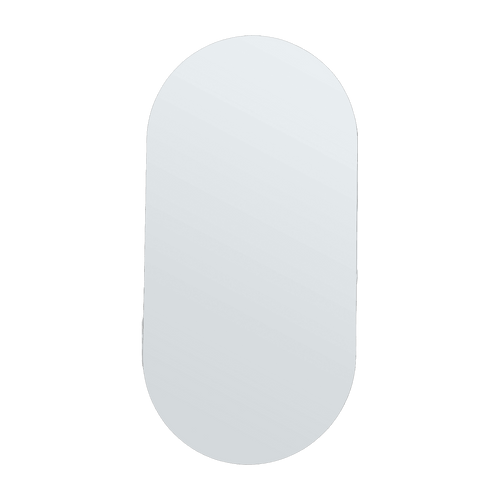
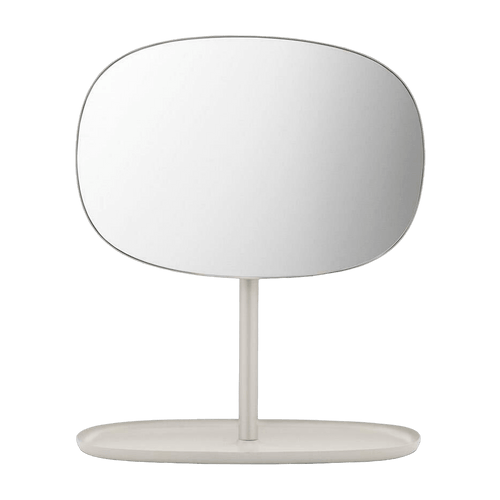
Above a vanity unit, the bottom of the mirror does not go below 100 cm from the floor, since the worktop is at 85 or 90 cm. A child whose eyes are lower than the bottom of the glass cannot see themselves, regardless of the size of the mirror. Three solutions can be combined: a step stool in front of the basin, a tall vertical mirror that serves adults of all heights, and an adjustable table mirror for smaller children. The oval Walls mirror by House Doctor, 100 x 50 cm, fixed with the bottom at 105 cm, covers 105 to 205 cm from the floor. The Flip by Normann Copenhagen, a pivoting table mirror 34.5 cm high, sits on the worktop and tilts towards a face positioned lower down.

Mirror height for a wheelchair user

In establishments open to the public, the decree of 20 April 2017 (article 12) requires that the mirror of an accessible washbasin be usable by a wheelchair user, without specifying a precise height. This text does not apply to private housing, but its logic can be transposed. Manufacturers of sanitary equipment adopt a practical benchmark: bottom of the glass at a maximum of 105 cm from the floor when the mirror is not tiltable. With a vanity worktop at 85 cm, this benchmark leaves 15 to 20 cm between the worktop and the mirror. With a worktop at 90 cm, limit the gap to 15 cm.

Placed on the floor, a full-length mirror reflects a seated person as well as a standing person. The Tess by Zuiver, 165 x 38.5 cm, features in the freestanding mirrors.

Children, short height, wheelchair: adjusting the mirror height
UserMeasurement to takeMirror adjustment
Standing adult Eye level, standing Centre of mirror at 160–165 cm, or mirror covering eye level
Child Eye level, standing, to be adjusted as the child grows Step stool in front of basin or adjustable table mirror placed on worktop
Adults of very different heights Eye level of shortest and tallest person Vertical mirror 80–120 cm high, bottom edge 15–20 cm from worktop
Wheelchair user Eye level, seated Bottom edge of mirror at maximum 105 cm from floor (standard guideline), or tiltable mirror

No standard specifies the height of a mirror in a dwelling. The decree of 20 April 2017 concerns establishments open to the public and does not specify the mirror height: the 105 cm dimension is a practical guideline, to be checked by measuring the eye level of the person concerned.
Round Moebe mirror hanging from a brass rod on a midnight blue wall, above a slim wooden console
Moebe, 50 cm round: narrower than the console it sits above, it lets the sides breathe.

View the Freestanding Mirrors collection →

The dimensions to know room by room

Once the height is fixed, the size is deduced from the furniture and the room. The mirror must dialogue with its surroundings: neither wider than the console it overhangs, nor lost on a large bare wall. The dimensions below are practical benchmarks, to be cross-referenced with the actual dimensions of your furniture.

Mirror dimensions: the rule in relation to furniture

The width of the mirror aligns with that of the furniture placed below. Two options work: the same width, for a monolithic ensemble, or two-thirds to three-quarters of the furniture's width, to let the sides breathe. A mirror wider than the furniture unbalances the composition, unless it occupies the entire wall of a bathroom. For a round mirror, note the diameter: 50 to 60 cm above a single basin, 80 to 110 cm above a console or sideboard measuring 120 to 160 cm.

Bathroom mirror dimensions: single or double basin

Above a single basin measuring 60 to 80 cm, a mirror 50 to 80 cm wide and 60 to 80 cm high covers the need. Above a double-basin unit measuring 120 to 140 cm, either one large horizontal mirror 100 to 140 cm wide, or two identical mirrors of 50 to 60 cm centred on each basin. The Halo bevelled mirror, 100 x 60 cm, illustrates the first case; two Walls round mirrors, 50 cm illustrate the second. The magnifying mirror remains a complement: the Tesia by Nordal measures 39 x 27 cm and flips over for x3 magnification.

Bathroom, hallway, bedroom, living room mirror size: benchmarks

In the hallway, a mirror serves to check yourself before going out and to add depth to an often narrow space: a round one measuring 70 to 90 cm or a vertical one 40 to 50 cm wide by 120 to 160 cm high. In the bedroom, a full-length mirror is essential, wall-mounted or freestanding, 40 to 60 cm wide and 150 to 190 cm high for the freestanding model. In the living room, it plays the role of a painting: 80 to 120 cm above a sideboard, up to 150 cm for a free wall. In a corridor, a horizontal format 100 to 150 cm wide, centred at eye level, visually widens the passage.

Very large mirror: when a large format enlarges the room

A very large mirror, from 120 cm wide or high, visually doubles the room on one condition: reflecting something worthwhile, a window, a pendant light, a bookcase, and not a bare wall or a door. Placed on the floor against the wall of a living room or bedroom, it requires no drilling and can be moved at will. The Walls oval mirror, 150 cm and the large oak standing mirror by Hübsch, 188 cm fulfil this role. Large formats can be found in the mirrors.

The dimensions to know room by room
RoomMain useSize guideRecommended shape
Bathroom, single basin (60-80 cm) Daily grooming 50 to 80 cm wide, 60 to 80 cm high, or round 50 to 60 cm Round, rectangular, organic
Bathroom, double basin (120-140 cm) Two people One mirror 100 to 140 cm wide or two mirrors 50 to 60 cm Horizontal rectangular or two round
Entrance hall Check appearance, enlarge Round 70 to 90 cm or vertical 40-50 x 120-160 cm Round, vertical with shelf
Bedroom Full-length view 40 to 60 cm wide, 120 to 190 cm high Rectangular, oval, freestanding
Living room, above a sideboard Decor, light Two-thirds to three-quarters of the furniture width, 80 to 120 cm Round, organic, rectangular
Living room, open wall Enlarge 110 to 150 cm, freestanding or hung Oval, XXL round, rectangular
Hallway Widen 100 to 150 cm wide, horizontal Horizontal rectangular
Round Moebe mirror hanging from a brass rod on a midnight blue wall, above a slim wooden console
Moebe, 50 cm round: narrower than the console it sits above, it leaves breathing space at the sides.

View the Mirrors collection →

Round, oval, rectangular or organic: which shape for which room

Shape changes the perception of a room as much as size does. A simple rule: a mirror with curves softens geometric decor, whilst a rectangular mirror structures a wall already full of curves.

The round mirror

The round is the easiest shape to position: it has no direction, centres on any piece of furniture and softens the lines of basins and consoles. Between 50 and 80 cm in diameter, it suits the bathroom and hallway; between 90 and 110 cm, it becomes the centrepiece of a living room. The Circum by AYTM in smoked glass, 110 cm brings a warm tint to the reflection. All diameters are gathered in the round mirrors.

The oval mirror

The oval combines the softness of the round and the height of a vertical: it is the ideal shape for a full-length mirror in a bedroom or a hallway mirror on a narrow wall. A 50 x 100 cm oval is sufficient above a console; 70 x 150 cm resting on the floor provides a full-length reflection. Models can be found in the oval mirrors.

The rectangular mirror

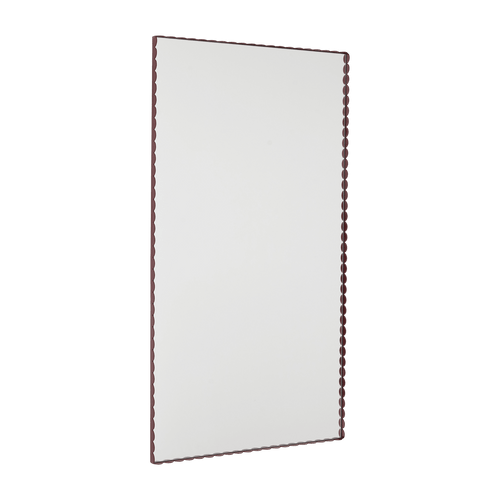
Vertical, it serves to see oneself full-length; horizontal, it widens a corridor or hangs above a long sideboard. Its sharp angles suit understated interiors and pair with wooden or metal frames. The Arcs L mirror by HAY, 72.5 x 133.5 cm rounds the corners for greater softness. Find vertical and horizontal formats in the rectangular mirrors.

Organic shapes

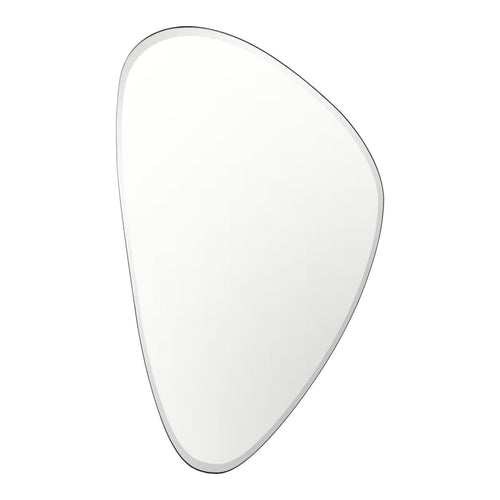
Without angles or symmetry, organic mirrors hang alone on a plain wall, where their silhouette acts as a picture. They tolerate competition from other frames poorly. The Pond by Ferm Living, 63.5 x 110 cm is the best-known example. Free-form silhouettes sit alongside rounds and ovals in the wall mirrors.

Large round AYTM Circum mirror in smoked glass placed on the floor against a brown wall, between paintings and a side table
AYTM Circum: 110 cm diameter in smoked glass. At this size, the circle becomes the centrepiece and tints the reflection.

View the Round Mirrors collection →

Brass, wood, black metal or frameless: which frame to choose

The frame gives the style and affects the total thickness of the mirror: from 1.5 cm for a slim metal frame (Ferm Living Pond) to 3.5 cm for a coloured glass frame (HAY Arcs), according to the manufacturers' specifications. A mirror with a shelf, such as the oak model by Hübsch, reaches 23 cm in depth and requires reinforced fixing.

Brass and gold metal

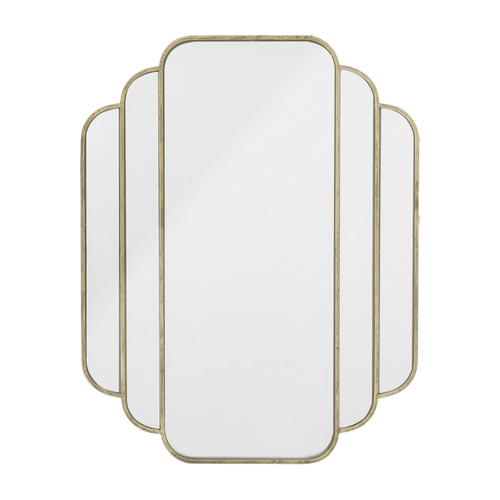
Brass warms up a white bathroom and pairs with gold-toned taps. A slim frame, like that of the Moebe round brass mirror, 50 cm, almost disappears; a wide gold metal frame, like the Mas by Bloomingville, 63 x 80 cm, is visible from afar. Unlacquered brass develops a patina over time: it's a choice, not a defect. The gold mirrors collection brings together both families.

Wood and oak

Natural oak softens a hallway or bedroom and combines effortlessly with Scandinavian furniture. It dislikes stagnant moisture: in a bathroom, reserve it for ventilated spaces and keep it away from the shower. The Hübsch oak mirror with shelf, 55 x 120 cm adds a 23 cm deep shelf in the hallway.

Black metal and steel

Black metal draws a graphic line, like a glass partition, and withstands moisture without flinching when lacquered. It structures full-length mirrors, such as the Adorn by Ferm Living, 45 x 159 cm. Steel, iron and brass frames are brought together in the metal mirrors.

Frameless or bevelled

A frameless mirror blends into the wall and remains the simplest choice in a bathroom. The bevel, this angled band of a few centimetres around the edge, catches the light and draws a frame without adding one. The Ruby by Broste Copenhagen, 60 x 120 cm combines a bevel with a black-tinted edge. Frameless models can be found in the glass mirrors.

Brass, wood, black metal or frameless: which frame to choose
TypeTypical heightFixingRoom
Wall mirror 40 to 130 cm Appropriate wall plugs, minimum 2 fixing points Bathroom, hallway, corridor, living room
Standing or floor mirror 150 to 190 cm (Zuiver Tess 165 cm, Hübsch 188 cm) None, discreet wall attachment recommended Bedroom, dressing room, hallway
Table mirror 25 to 35 cm (Normann Flip 34.5 cm, Hübsch Smize 30 cm) None Dressing table, chest of drawers, bathroom
Hübsch wall mirror with rounded oak shelf holding notebooks and glasses, on a pale yellow wall
Hübsch, mirror with oak shelf: 55 × 120 cm and a shelf 23 cm deep, which requires reinforced fixing.

View the Gold Mirrors collection →

Wall mirror, standing mirror or table mirror?

Three families, three uses. The wall mirror is fixed and frees up floor space: it's the solution for the bathroom and hallway. The freestanding mirror or mirror leaning against the wall, 150 to 190 cm high, gives a full-length reflection without drilling and can be moved: it suits renters and bedrooms. The table mirror, 25 to 35 cm high, sits on a dressing table, chest of drawers or bathroom shelf.

Two points of attention for freestanding models. Firstly, stability: a mirror tilted against a wall rests on two points, it's best to attach it discreetly to the wall when children are present. Secondly, the angle: a few degrees are enough for a flattering reflection; beyond that, the mirror shortens the silhouette. The Flip by Normann Copenhagen, 28 x 34.5 cm, and the Smize by Hübsch, 29 x 30 cm, represent the family of table mirrors. Freestanding and table models are brought together in the freestanding mirrors.

Wall mirror, standing mirror or table mirror?
TypeTypical heightFixingRoom
Wall mirror 40 to 130 cm Fixings suited to the wall, 2 points minimum Bathroom, hallway, corridor, living room
Floor-standing or free-standing mirror 150 to 190 cm (Zuiver Tess 165 cm, Hübsch 188 cm) None, discreet wall attachment recommended Bedroom, dressing room, hallway
Table mirror 25 to 35 cm (Normann Flip 34.5 cm, Hübsch Smize 30 cm) None Dressing table, chest of drawers, bathroom
Normann Copenhagen Flip table mirror placed on a marble tray, next to lidded boxes
Normann Copenhagen Flip: 28 × 34.5 cm in lacquered steel. The table mirror sits on a dressing table or chest of drawers, without drilling.

View the Freestanding Mirrors collection →

Measure, mark, fix: hanging a mirror above a basin in 6 steps

Installing a mirror above a basin always follows the same order: size first, height second, lighting last. The six steps below follow the guide's reference points in the order they are used.

  1. Measure four dimensions. The height of the vanity top, the width of the vanity unit, the height of the tap spout and the eye level of each user.
  2. Choose the size of the mirror. The width of the mirror is equal to that of the unit or between two-thirds and three-quarters of this width. The height of the mirror must allow the glass to cover the eyes of the shortest and tallest user.
  3. Calculate the position of the bottom of the mirror. Add 15 to 20 cm to the height of the top, up to 25 cm if the tap is high. With a top at 88 cm, the bottom of the mirror is 105 cm from the floor.
  4. Mark on the wall. Mark the vertical axis of the basin, not that of the wall, then a horizontal line with a spirit level. Measure on the back of the mirror the distance between the fixings and the bottom edge, and transfer this distance to the wall.
  5. Drill and use wall plugs according to the surface. Wall plugs differ for plasterboard, brick and concrete. Allow for at least two fixings for a mirror over 60 cm. On a tiled wall, drill without hammer action using a tile drill bit.
  6. Hang, check the level, then install the lighting. A wall light is fixed 10 to 15 cm above the top of the mirror.

Worked example: the Mas mirror by Bloomingville, 63 x 80 cm, hung vertically with the bottom at 105 cm, covers from 105 to 185 cm from the floor. The wall light is then positioned between 195 and 200 cm. Lighting suited to this use is brought together in the bathroom wall lights.

Method used in this guide: the heights and spacings are practical benchmarks, to be adjusted to the occupants' height. The dimensions of the models mentioned come from the manufacturers' specifications reproduced on the product pages.

Ferm Living Pond mirror with organic contours above a light-coloured basin, between two wall lights and behind a copper tap
Ferm Living Pond: 63.5 x 110 cm, above a basin. A tall mirror allows everyone to find their reflection, whatever their height.

View the Bathroom Wall Lights collection →

Practical Examples

A 4 m² bathroom with an 80 cm vanity unit

The worktop is at 88 cm. The bottom of the mirror is fixed at 105 cm: an 80 cm tall mirror then covers 105 to 185 cm from the floor, which encompasses the eye level of most adults; allow 60 to 80 cm in width. An 80 cm round mirror is suitable. A 100 x 60 cm rectangle positioned horizontally gains width for two people, but its glass stops at 165 cm from the floor: it is suitable if users are under 1.75 m tall. The Halo mirror by The Cool Republic meets this requirement.

A 1.20 m wide entrance hall with console table

The console table measures 100 x 80 cm high. A 70 to 80 cm round mirror, bottom at 100 cm from the floor, leaves room for a lamp on the console table and enlarges the passageway. The Walls by House Doctor in 80 cm is suitable, with a discreet grey frame. Matching console tables are in the console tables.

A rented bedroom, no drilling allowed

The mirror stands on the floor, leaning against the dressing room wall at a slight angle. A model 150 to 170 cm tall and 40 to 55 cm wide provides a full-length reflection for the whole family. The Tess by Zuiver, 165 cm fits these requirements. Other freestanding models can be found in the freestanding mirrors.

Large oval House Doctor Walls mirror placed on the floor against a white wall, beneath a silver metal pendant light
House Doctor Walls oval: 70 × 150 cm, placed on the floor against the wall. A full-length reflection without drilling—the solution for rented bedrooms.

View the Console Tables collection →

Wall-hung basin, double basin 140 cm: two bathrooms costed

A small cloakroom with wall-hung basin at 85 cm

The top of the wall-hung basin sits 85 cm from the floor and the basin measures 70 cm wide. The bottom of the mirror fixes between 100 and 105 cm. A mirror 60 to 65 cm wide and 80 cm high stays within the width of the basin and covers the eye level of an adult. The Mas mirror by Bloomingville, 63 x 80 cm, positioned with the bottom at 100 cm, covers 100 to 180 cm from the floor. A wall light is placed 10 to 15 cm higher, between 190 and 195 cm.

A family bathroom with 140 cm double basin

Two options exist above a 140 cm double basin unit: one large horizontal mirror or two identical mirrors. The Halo bevelled mirror, 100 x 60 cm, positioned horizontally with the bottom at 105 cm, covers 105 to 165 cm from the floor. This format works if the eyes of the tallest user remain below 165 cm. In a family with very different heights, two vertical mirrors cover a higher range: two Walls oval mirrors, 100 x 50 cm, bottom at 105 cm, cover 105 to 205 cm.

When installing two mirrors, centre each mirror on the axis of its basin, not on the unit. On a 140 cm unit whose basins are centred on each half, the axes sit at 35 and 105 cm from the left edge. Two mirrors 50 cm wide then leave 20 cm between them and 10 cm on each side. Softened vertical formats can be found in the oval mirrors.

Wall-hung basin, double basin 140 cm: two bathrooms costed
CriterionOne large horizontal mirrorTwo identical mirrors
Width guideline for a 140 cm unit 100 to 140 cm 50 to 60 cm each
Centring On the unit's axis Each mirror on its basin's axis
Reflection Continuous, two people side by side One reflection per person
Height covered, bottom at 105 cm 105 to 165 cm with the Halo 100 x 60 cm positioned horizontally 105 to 205 cm with two Walls 100 x 50 cm ovals
Lighting One long wall light or two wall lights above the mirror One wall light per mirror
Suitable for Two adults of similar heights A family with very different heights

View the Oval Mirrors collection →

Maintenance, installation and lifespan

A mirror is cleaned with a slightly damp microfibre cloth, then a dry cloth, avoiding liquid running down the edges: it's through the edge that moisture attacks the silvering and creates black spots, what is called a foxed mirror. Ammonia-based products and abrasive sponges should be avoided on brass, wood or lacquered frames; a soft cloth is sufficient, as the Nordal and Orchid Edition product sheets remind us.

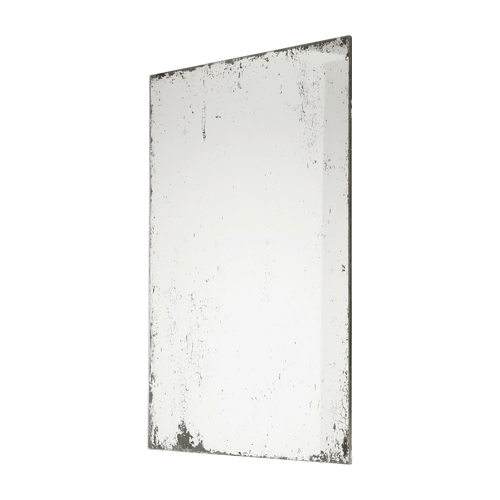
A foxed mirror cannot be restored: damaged silvering cannot be repaired at home. You can mask the spots with a wider frame, embrace the patina, or replace the glass at a mirror maker's whilst keeping the frame. Conversely, deliberately ageing a mirror is a workshop job; publishers offer mass-produced aged mirrors, safer than a homemade acid treatment.

For installation, a minimum of two wall fixings for a mirror over 60 cm, with plugs suited to the surface (plasterboard, brick, concrete). Wall mounting with mirror adhesive is possible on a sound, flat wall, but it makes removal destructive: reserve it for small frameless mirrors. In a bathroom, opt for a mirror with a lacquered metal frame or frameless, and installation that keeps the bottom of the mirror away from splashes from the basin. All formats are in the mirrors.

View the Mirrors collection →

Replacing an old bathroom mirror without retiling

Replacing a mirror without touching the tiles rests on a simple idea: the new mirror must cover everything the old one hid, i.e. the holes, glue marks and sometimes an area of untiled wall. The sequence unfolds in five steps.

  1. Identify the fixing of the old mirror. Visible brackets or screws indicate a screwed mirror. The absence of any visible fixing most often indicates a glued mirror.
  2. Take the measurements of the old mirror. Note its width, height, the distance between its lower edge and the worktop, then the spacing of the holes once the mirror is removed.
  3. Choose a model larger in both dimensions. A rectangular mirror that is wider and taller covers the old footprint. A round mirror only covers a former rectangle if its diameter exceeds the diagonal of that rectangle: 100 cm for a former mirror of 60 × 80 cm.
  4. Remove the old mirror. A screwed mirror is unscrewed by two people. A glued mirror cannot be removed without breaking: cover the glass with adhesive tape, wear gloves and goggles, or entrust the removal to a glazier when the glass is large.
  5. Fix the new mirror. Reuse the old holes if their spacing matches the fastenings of the new mirror. Otherwise, drill new holes without percussion, preferably in a tile joint, simpler to repair than a tile. The old holes remain hidden by the mirror.

Check two measurements before buying. The bottom of the new mirror must remain 15 to 20 cm above the washbasin worktop. The width of the new mirror must remain equal to or less than that of the washbasin unit. If the old footprint exceeds these limits, a horizontal rectangular mirror covers more width without descending towards the worktop. Horizontal and vertical formats can be found in the rectangular mirrors.

View the Rectangular Mirrors collection →

Trends 2026: what our customers are choosing

What orders placed on The Cool Republic between January and September 2026 in the Mirrors collection show. Shares are counted by number of orders, not quantities, so that a large purchase doesn't weigh more than another.

What sells most in 2026

  • Colours: brown (30%), transparent (21%), gold (13%).
  • Materials: glass (40%), steel (10%), brass (8%).
  • Shapes: rectangular (42%), organic (25%), round (21%).

The most requested brands

By share of orders: HKliving (23%), The Cool Republic (18%), House Doctor (11%), Ferm Living (8%).

The most ordered models since January

Method: orders placed on thecoolrepublic.com from 1 January to 30 September 2026, counted by number of orders containing the product; only models still on sale are listed. Survey updated quarterly.
View the Mirrors collection →

The criteria that matter

The criteria that matter
CriterionWhat it changesFigure of referenceThe pitfall
Height of the centre The comfort of all users 160 to 165 cm from the floor (standard guideline) Copying the height from a magazine photo without measuring the eye level of the occupants
Gap above the furniture Clearance for the tap, space for a lamp 15 to 20 cm above a basin, 15 to 25 cm above a console Placing the mirror directly on the surface: splashes and cut-off reflection
Width relative to the furniture The balance of the composition Same width, or two-thirds to three-quarters of the furniture's width A mirror wider than the console it sits above
Height for a full-length reflection Reflection of the entire body At least half the user's height, 110 to 160 cm in practice Buying 2 m of mirror when 1.10 m is enough if well positioned
Shape Softness or structure of the wall Round 50-80 cm in a bathroom, 90-110 cm in a living room A 50 cm round above a 180 cm sideboard
Frame and thickness Style, weight, fixing 1.5 cm (Ferm Living Pond) to 3.5 cm (HAY Arcs) total thickness A raw oak frame next to a shower without ventilation
Functions Lighting, magnification Integrated LED 3,000 K variable (Normann Illu), x3 magnification (Nordal Tesia) An IP20 illuminated mirror installed in the shower area

Model comparison

ModelPriceShapeDimensionsFrameInstallationRecommended room
Large mirror in black iron 45 x 159 cm Adorn €279,20n/an/an/an/an/a
Walls grey round mirror 80 cm €134,95n/an/an/an/an/a
Bevelled designer mirror 100 x 60 cm Halo €179,00n/an/an/an/an/a
Mirror in glass and white steel 65 x 50 cm Illu €401,25n/an/an/an/an/a
Freestanding mirror in black steel 165cm Tess €103,20n/an/an/an/an/a
Large oak freestanding mirror €301,00n/an/an/an/an/a
Oval mirror 150 cm Walls €230,00n/an/an/an/an/a
Circum round mirror in smoked glass 110 cm €223,30n/an/an/an/an/a
Organic-shaped dark chrome mirror 63.5 x 110 cm Pond €349,00n/an/an/an/an/a
Black bevelled wall mirror 120 cm Ruby €239,00n/an/an/an/an/a
Bordeaux rectangular mirror L 72.5 x 133.5 cm Arcs €519,20n/an/an/an/an/a

Prices shown are the catalogue prices at the time you read this page.

Which brand to choose

Ferm Living

Scandinavian elegance, between softness and character

See the Ferm Living brand →
House Doctor

Scandinavian decoration with mixed influences

See the House Doctor brand →
HAY

Contemporary Danish design for everyday life

See the HAY brand →
AYTM

Sophisticated Scandinavian chic design

See the AYTM brand →
Hübsch

Danish design guided by joie de vivre

See the Hübsch brand →

Mistakes to avoid

  • Hanging the mirror too high: centre at 175 cm or higher means people under 1.70 m tall only see their forehead.
  • Positioning the bottom of the mirror less than 10 cm from the basin surface: permanent splashes and tap obscuring the reflection.
  • Choosing a mirror wider than the console or vanity unit it hangs above.
  • Buying a 2 m mirror for a full-length view when a 110 to 160 cm model, properly positioned, is sufficient.
  • Installing a raw oak frame or an IP20 illuminated mirror in the shower zone.
  • Fixing a large framed mirror with mastic: removal tears off the wall and the frame.
  • Placing a large mirror facing a bare wall or door: it doubles the emptiness instead of doubling the light.

Frequently asked questions

What height for a bathroom mirror?
The centre of the mirror is positioned at eye level, i.e. 160 to 165 cm from the floor for an adult (standard reference). Above a vanity unit whose top is at 85 or 90 cm, leave 15 to 20 cm between the top and the bottom of the mirror, which ends up around 100 to 110 cm. A mirror 60 to 80 cm high brings its centre to the right height.
What height between basin and mirror?
Allow 15 to 20 cm between the worktop and the bottom of the mirror. This gap clears the mixer tap, protects the silvering from water splashes and leaves room for a shelf or soap dish. If the mixer tap is tall, for example with a countertop basin, increase the gap to 25 cm so that the spout doesn't interrupt the reflection.
At what height should a vertical mirror be fixed?
A vertical full-length mirror is fixed with the bottom edge between 20 and 60 cm from the floor and the top edge at eye level or above. The law of reflection means that a mirror half your height is sufficient, but a format of 110 to 160 cm high avoids having to stand at a precise point.
At what height should a horizontal mirror be fixed?
A horizontal mirror is centred at eye level, 160 to 165 cm, when it is alone on a hallway wall. Above a sideboard or vanity unit, start from the furniture: bottom of the mirror 15 to 25 cm above the top. Its width remains equal to or slightly less than that of the furniture to maintain a balanced composition.
How to position a mirror in an entrance hall?
Place it near the door, at eye level, preferably facing or perpendicular to a light source so that it reflects it into the corridor. Above a console table, leave 15 to 25 cm between the top and the bottom of the mirror and choose a width smaller than that of the furniture. A round mirror of 70 to 90 cm is the easiest format to get right.
How to position a mirror above a sideboard?
Centre the mirror on the sideboard, 15 to 25 cm above the top, and limit its width to two-thirds or three-quarters of that of the furniture: 80 to 120 cm for a sideboard of 160 to 180 cm. Leave a lamp or tall object on one side to break the symmetry, and avoid the mirror reflecting a door or bare wall.
How to stick a mirror to the wall?
Adhesive fixing is done with a special neutral mirror mastic that doesn't attack the silvering, on a clean, dry and flat wall, in vertical beads to allow air to circulate. Hold the mirror in place for 24 hours with wedges. Reserve this method for small unframed mirrors: a glued mirror cannot be removed without breakage or damaging the wall.
Foxed mirror: how to restore it?
The black spots on a foxed mirror come from the silvering attacked by moisture that has entered through the edge; they cannot be repaired at home. Three solutions: accept the patina, hide the perimeter with a wider frame, or have the glass replaced by a mirror specialist while keeping the frame. To prevent this, always wipe the edges and avoid ammonia-based cleaners.