



Skip to content

-5% de remise supplémentaire sur tout notre OUTLET avec le code EXTRA5

Dès 150€ d’achats chez Serax, une carafe Fish&Fish est offerte. Ajoutez-la à votre panier !

BLACK MONTH Xmas Shop
Muuto Fiber chairs on castors in several colours around a large table, in front of a bay window

Buying guide

How to choose an office chair: height, adjustments and comfort

An office chair is judged by its adjustments before its appearance: seat height, backrest, armrests, base. This guide provides the benchmarks of the EN 1335 standard and ergonomics, compares twelve models from the catalogue and classifies them by use, from a full day of working from home to occasional desk work.

12 models compared5 settings explainedupdated September 2026

Find your desk chair in 30 seconds

1 / 4

How long, and where?

Beyond four hours a day, aim for an adjustable seat, on castors, with armrests.

Castors or swivel?

Castors serve prolonged work; swivel turns on the spot and stays where you put it.

With or without armrests?

Armrests relieve the shoulders; without, the chair slides entirely under the worktop.

What budget do you have in mind?

The upholstery and mechanism account for most of the price difference.

Passer et lire le guide

Our recommendation

Deux alternatives sérieuses

Key takeaways

Choose a chair with a height-adjustable seat and a backrest that supports the lower back. Adjusted correctly, it positions your elbows at the level of a desk 72 to 75 cm high, with feet flat on the floor: the seat height should then be between 42 and 52 cm depending on your height, a benchmark consistent with standard EN 1335-1. For use exceeding four hours per day, add armrests at worktop height and castors.

  • Essential adjustment: seat height, to bring the elbows level with the desk, feet flat.
  • Seat: 42 to 52 cm high depending on height; three to four fingers' space between the edge of the seat and the back of the knee.
  • Backrest: it supports the small of the back; the longer you sit, the more enveloping and adjustable it must be.
  • Armrests: level with the worktop or absent; too high, they raise the shoulders and prevent the chair from being drawn close.
  • Beyond four hours a day: castors on a five-branch base, adjustable seat and a break every hour.

The dimensions you need to know

The benchmarks in this section come from the European standard EN 1335-1, which sets the dimensions of office work chairs, and from ergonomic usage benchmarks, named as such. The titles of the chairs in our office chair collection rarely give their dimensions: when they do, we quote them.

Office chair height

The useful height of an office chair is that of the seat, not the backrest. It is adjusted so that, when sitting at the back of the seat, your elbows are level with the desktop, forearms horizontal, and your feet rest flat on the floor, thighs horizontal or slightly inclined downwards. If both conditions cannot be met, prioritise the elbows and add a footrest.

Office chair seat height

For a fixed desk of 72 to 75 cm, the adjusted seat falls between 42 and 52 cm depending on your height: 42 to 45 cm around 1.60 m, 44 to 48 cm around 1.70 m, 47 to 50 cm around 1.80 m, 49 to 52 cm above 1.85 m. These values are a usage benchmark, deduced from the height of the hollow of the knee when wearing shoes; measure your own, seated, from the floor to the back of the knee.

Standard office chair height

There is no single standard height but an adjustment range. The EN 1335-1 standard provides for office work chairs a seat adjustable over a range of approximately 40 to 51 cm, a benchmark whose exact value depends on the type of chair. A kitchen or dining chair, fixed, is around 45 to 47 cm: it is suitable for occasional use, not for a full working day.

Office chair dimensions

On the floor, a five-branch base occupies a circle of 60 to 70 cm in diameter; a swivel chair with a wide seat goes beyond: 69 x 69 cm for the Rico by Ferm Living, 65 x 75 cm for the Audo swivel chair, dimensions read in their titles. Add 70 cm of clearance behind the desk to pull the chair back without touching the wall. For the seat, keep three to four fingers between its edge and the back of the knee: a seat that is too deep separates you from the backrest.

The dimensions you need to know
User heightSeat height (usage guide)With a fixed desk of 74 cm
1,55 à 1,65 m 42 to 45 cm seat raised to elbow level, footrest under the desk
1,65 à 1,75 m 44 to 48 cm direct adjustment, feet flat on the floor
1,75 à 1,85 m 47 to 50 cm direct adjustment, check knee clearance under the worktop
1.85 m and over 49 to 52 cm high seat; a desk of 75 cm or higher is more comfortable

Adjustment order: seat height (elbows level with the desk), seat depth (three to four fingers behind the knee), backrest (in the small of the back), armrests (level with the desk), screen (top of screen at eye level, at arm's length).

Workstation viewed from the side: seat 42 to 52 cm, desk 72 to 75 cm, top of the screen at eye level
Seat adjusted so that elbows rest at desk level, feet flat on the floor, screen at arm's length and top of the screen at eye level.

View the Office Chairs collection →

The five adjustments of an office chair

Seat height

This is the essential adjustment, via a gas lift operated by a lever under the seat: stand up slightly, pull the lever, the seat rises; sit down whilst holding it, and it descends. A chair without this adjustment suits only one user height and one desk height. In the catalogue, the titles that mention it say 'adjustable' or 'Gaslift': Swivel 5W by Normann Copenhagen, AAC 252 by HAY, Beetle by Gubi. See the office chair collection.

How to adjust the backrest of an office chair

Sit right back in the seat. If the backrest adjusts in height, position its most curved part at the small of your back, roughly at belt height. If it reclines, tilt it slightly backwards rather than keeping it upright. On a tilt mechanism, adjust the tension, often a knob under the seat, according to your weight: the backrest should follow your back when you lean backwards, without pushing you or giving way suddenly.

Armrests

They relieve the shoulders if they reach the level of the desktop, with elbows resting without raising the shoulders. Too high, they have the opposite effect; fixed and too long, they hit against the desk and prevent the chair from being pulled in. For a narrow desk or a bedroom, a chair without armrests slides entirely under the desktop. See the chair collection with armrests.

Seat depth and tilt

When the seat slides, adjust it to keep three to four fingers between its edge and the back of the knee. Some mechanisms also tilt the seat slightly forwards: the thighs drop a little, the pelvis opens. These adjustments are found mainly on technical office chairs; on a designer chair, check on the product sheet what the mechanism allows.

How to sit properly on an office chair

Right back in the seat, back against the backrest, feet flat, elbows level with the desktop, shoulders relaxed, screen at arm's length with its top edge at eye level. Then move: no position can be held for eight hours. Stand up at least once an hour, alternate between sitting and standing when possible, and change your support during the day. To adjust the desk itself, read our guide to desk height and dimensions and see the desk collection.

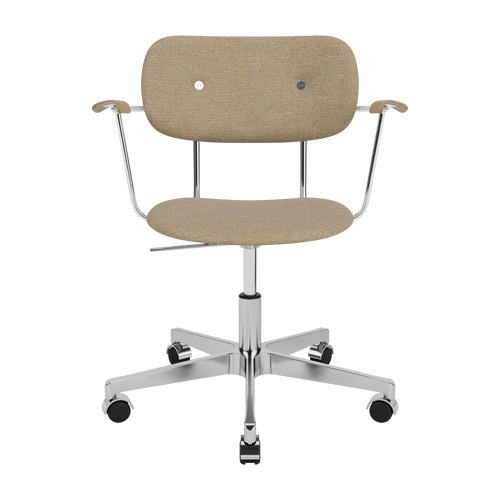
Audo office chair with castors in aluminium and natural bouclé fabric, wooden armrests, in front of a wooden desk
Audo rolling chair, 65 × 75 cm: check the product sheet for the adjustments available, starting with the seat height.

View the Desks collection →

Design office chair or technical ergonomic seat: which to choose

A designer office chair and a technical ergonomic chair do not meet the same need. The designer office chair starts from a manufacturer's seat, shell or armchair, mounted on a swivel or castored base. The technical ergonomic chair starts from the mechanism: each part of the chair adjusts separately.

What a technical ergonomic chair adjusts in addition

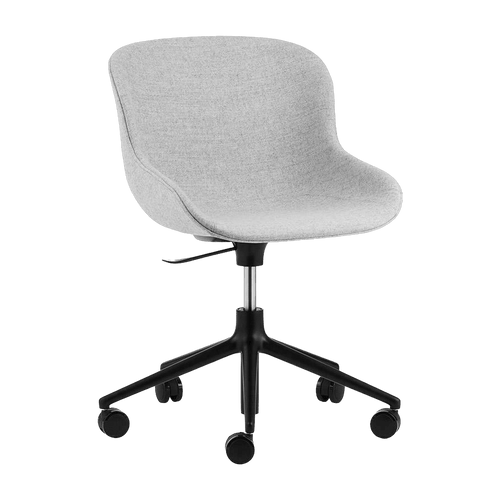
A technical ergonomic chair generally adds four adjustments to seat height: an adjustable lumbar support, a synchronised mechanism that tilts the seat and backrest together, a sliding seat depth and adjustable armrests. The backrest of a technical ergonomic chair is often stretched with a mesh that lets air through.

What a designer office chair adjusts

In The Cool Republic's office chair collection, 26 items feature an adjustable height or gas lift, under the words 'adjustable' or 'Gaslift', including the Swivel 5W and Hyg by Normann Copenhagen, AAC 252 2.0 by HAY, Beetle by Gubi, Paulistano by Objekto. No item in this collection mentions adjustable lumbar support, a synchronised mechanism or a mesh backrest. The compromise of a designer office chair is therefore clear: fewer adjustments, a look that fits in with the living room.

How to choose between the two

  • You sit all day and want to adjust lumbar support to the centimetre: opt for a technical ergonomic chair, on the advice of a health professional in case of pain.
  • You work more than four hours a day without particular pain: a designer office chair with adjustable height, castors and armrests covers the three basic adjustments.
  • You work two or three hours a day in a living space: a designer swivel chair is sufficient.
Design office chair or technical ergonomic seat: which to choose
CriterionDesigner office chairTechnical ergonomic chair
Starting point a manufacturer's seat, shell or armchair a mechanism with separate adjustments
Seat height adjustable on "adjustable" or "Gaslift" models adjustable
Lumbar support provided by the backrest shape adjustable
Tilt depending on mechanism, check product sheet synchronised seat and backrest
Armrests present or absent depending on model adjustable
Backrest shell, fabric or leather often mesh
Recommended use a few hours to a full day, office visible in living room entire days seated, need for fine adjustments

Beyond four hours of work per day, three adjustments come before the style of the office chair: seat height, castors and armrests.
Ferm Living Rico swivel chair in white bouclé in front of a wooden desk, in a room with brown curtains
Ferm Living Rico: a swivelling seat measuring 69 x 69 cm, wide enough to sit cross-legged.

View the Office Chairs collection →

For your back, working from home, without armrests or cross-legged: which chair for which use

Which office chair for back support

A chair whose backrest follows the curve of the lower back and whose seat adjusts in height to keep the feet flat on the floor. Lower back support matters more than the total height of the backrest. No chair can cure back pain: if you experience pain, seek advice from a healthcare professional, who may recommend a specific technical seat. See the office chair collection.

Which office chair for working from home

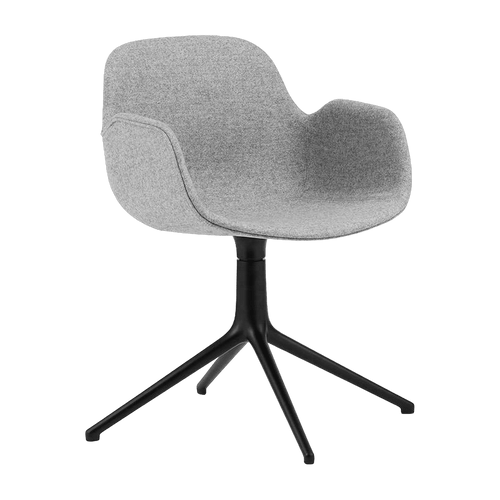
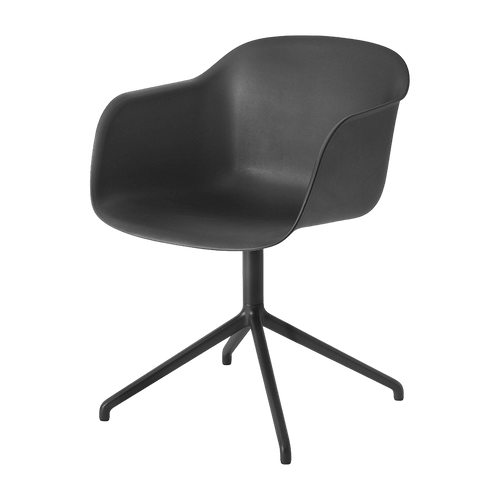
It all depends on the number of hours. Beyond four hours a day, aim for a chair with an adjustable seat, on castors with a five-branch base, and with armrests: the Swivel 5W by Normann Copenhagen, the Kendo by Hem. For two or three hours, a design swivel chair does the job and fits better in the living room: the Fiber by Muuto, the Form by Normann Copenhagen. See the Normann Copenhagen chairs.

The office chair without armrests

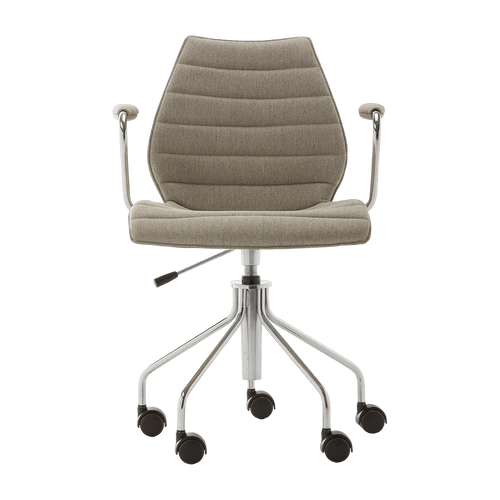
It tucks completely under the desk top, leaves the arms free for drawing or playing an instrument, and suits the narrow desks of bedrooms. In return, the shoulders alone bear the weight of the arms: reserve it for uses of a few hours. In the catalogue: the AAC 252 2.0 by HAY, the Fiber by Muuto on castors, the Maui by Kartell. See the HAY chairs.

Office chair for sitting cross-legged

To fold the legs onto the seat, you need a wide seat without armrests that obstruct the knees. Swivel chairs with large seats lend themselves to this: the Rico by Ferm Living, 69 x 69 cm as stated, the wheeled chair by Audo, 65 x 75 cm. Bear in mind that the cross-legged position is better maintained in short sequences, alternating with feet on the floor. See the Muuto chairs for other enveloping seats.

The ergonomic seat with dynamic sitting

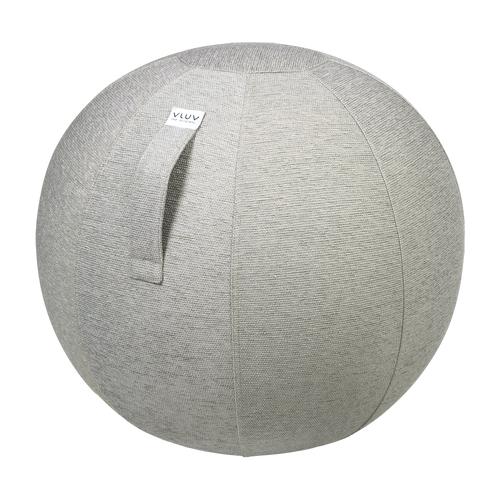
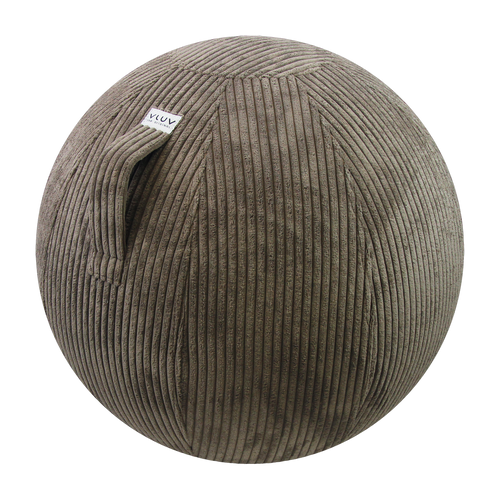
The ergonomic seats by VLUV, without backrest, compel the body to hold itself and move constantly. They are chosen by size, from 50 to 70 cm depending on the model, according to the user's height indicated on the product sheet. They are taken as a complement to a chair with a backrest, to alternate during the day, not to replace it. See the ergonomic office chair collection.

White bouclé Ferm Living Rico swivel chair in front of a wooden desk, in a room with brown curtains
Ferm Living Rico: a swivelling seat measuring 69 × 69 cm, wide enough to sit cross-legged.

View the Ergonomic office chairs collection →

Swivel 5W, AAC 252 2.0 or Beetle: head-to-head comparison

The Swivel 5W by Normann Copenhagen, the AAC 252 2.0 by HAY and the Beetle by Gubi are three office chairs with a shell, height-adjustable and on castors according to their titles. The three models fall within the same indicative budget range, €400 to €800. The difference lies in the armrests, footprint and material. The dimensions and materials in the table are taken from the product sheets in the catalogue; when a sheet does not provide information, the table indicates this.

Swivel 5W by Normann Copenhagen: with or without armrests

The Swivel 5W by Normann Copenhagen, designed by Simon Legald, is the only one of the three whose title announces armrests. It also exists without armrests, and each version comes in six polypropylene shell colours: black, white, grey, blue, green, red. The footprint of the Swivel 5W is 72.5 x 72.5 cm, the widest of the three. The Swivel 5W with armrests is suitable for a full day's work, when the forearms need support.

AAC 252 2.0 by HAY: without armrests, in recycled plastic

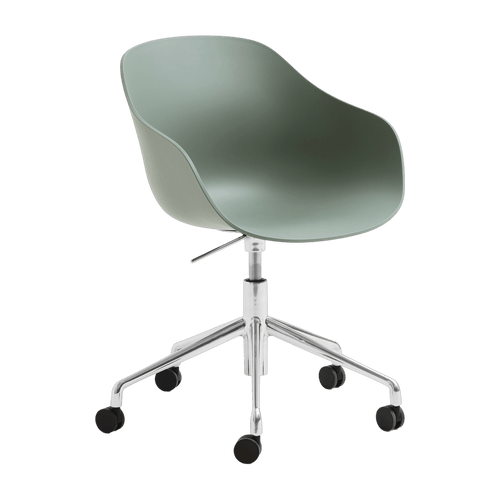
L'AAC 252 2.0 by HAY belongs to the About A Chair family. Its shell is made of recycled plastic, its legs of aluminium, and its title does not mention armrests. The AAC 252 2.0 measures 69 x 69 cm and 79 cm high and comes in four colours: green, dusty mint, peach and brick. It is suitable for a narrow desk or a bedroom, when the chair needs to slide under the worktop.

Beetle by Gubi: the enveloping shell

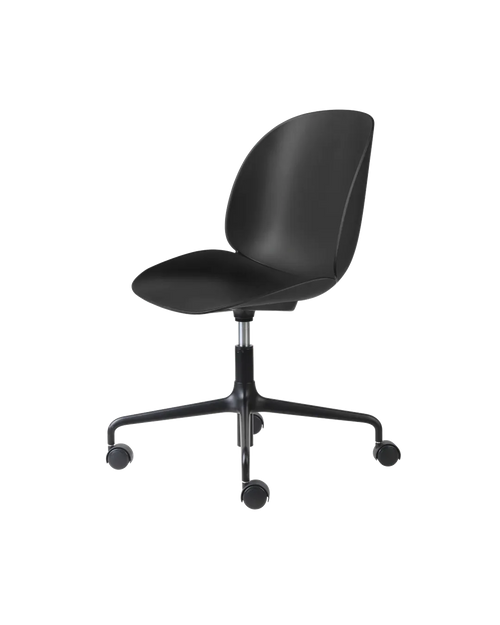
The Beetle by Gubi, designed by GamFratesi, is available in black, height-adjustable, with or without castors. The product sheet for the Beetle with castors indicates 49 cm wide, 58 cm deep and 81 cm high. The Beetle is suitable for a desk in the living room, when the chair remains visible all day.

Swivel 5W, AAC 252 2.0 or Beetle: head-to-head comparison
CriterionSwivel 5W, Normann CopenhagenAAC 252 2.0, HAYBeetle, Gubi
Height-adjustable yes yes yes
Castors yes yes yes, or version without castors
Armrests with or without, depending on version not according to the title not specified
Shell polypropylene recycled plastic plastic
Dimensions on the sheet 72.5 × 72.5 cm 69 × 69 cm, height 79 cm 49 × 58 cm, height 81 cm
Colours in the catalogue 6 per version 4 black
Designer Simon Legald Hee Welling GamFratesi
Recommended use all day, with armrests narrow desk, bedroom desk in the living room
Muuto Fiber armchairs in brown on black swivel base, around a table, in a room with wooden claustra
Muuto offers the Fiber as a chair or an armchair, on castors or on a swivel base: the same seat for the office and the dining room.

View the Office Chairs collection →

Castors, locking, riser and upholstery
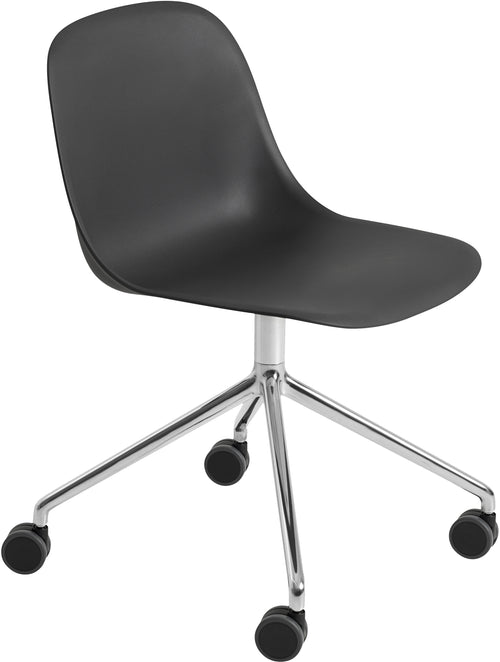
Castors, swivel or four legs

Castors allow you to roll back, reach for a file or turn around without standing up: they're the base for prolonged work. On wooden flooring, choose soft castors or use a protective mat; on carpet, hard castors roll better. A swivel base without castors turns on the spot and stays where you put it, which suits a desk set up in the living room. See the office chair collection.

How to lock an office chair

To stop it rolling, three solutions: brake castors, fixed glides instead of castors with the same stem diameter, or a non-slip mat under the chair. To lock the height, simply release the lever: the gas lift locks. To prevent the backrest from tilting, lock it in the upright position if the mechanism allows. See Normann Copenhagen chairs.

How to raise an office chair

Stand up slightly and pull the lever under the seat: the gas lift rises on its own. If the chair is already at its highest, a firm seat cushion gains a few centimetres, or the manufacturer offers a longer gas lift. Never dismantle a gas lift: it's under pressure. If the gap remains significant, perhaps the desk is too high for you. See the wooden desk collection.

Fabric, leather or plastic

The polypropylene or recycled plastic shell (HAY AAC, Normann Copenhagen Swivel) wipes clean with a sponge; a cushion makes it more comfortable over time. Fabric breathes better in summer and can be brushed. Leather (Hem Kendo, Objekto Paulistano) develops a patina and requires occasional maintenance with a suitable cream. See HAY chairs.

Three Muuto Fiber armchairs, one black on a swivel base, the other two on four legs, in a workshop with a concrete floor
Muuto Fiber: the same shell on a swivel base or on four legs; the swivel rotates on the spot and stays where you leave it.

View the Normann Copenhagen Chairs collection →

Which office chair brand should you choose

There is no objectively superior brand: each manufacturer has its own approach to the office chair. Here are the brands in our catalogue and what they offer.

Normann Copenhagen (Denmark) covers the widest range: Swivel in 4W or 5W, adjustable, with or without armrests, Form and Hyg in shell or upholstered versions, with gas lift on certain models. See brand Normann Copenhagen.

HAY (Denmark) offers the About A Chair family, designed by Hee Welling, in adjustable castor versions (AAC 252 2.0) or with armrests (AAC 24 2.0), in recycled plastic. See brand HAY.

Muuto (Denmark) offers the Fiber as a chair or armchair, on castors, swivel base, sled base or tube base: the same seat for the office and the dining room. See brand Muuto.

Kartell (Italy) produces the Maui by Vico Magistretti, on castors, with or without armrests. See brand Kartell.

Gubi (Denmark) reissues the Beetle by GamFratesi as an adjustable office chair, on castors or not. See brand Gubi.

Hem (Sweden) offers the Kendo as an office armchair, in several colours or in leather, silver or black base, with or without castors. See brand Hem.

Brown Muuto Fiber armchairs on black swivel bases, around a table, in a room with wooden screens
Muuto offers the Fiber in chair or armchair versions, with castors or on a swivel base: the same seat for the office and the dining room.

View the Muuto Chairs collection →

Ferm Living, &tradition, VLUV, Zuiver: other office chair brands

Four other brands in the catalogue offer at least three office chairs each. Ferm Living, &tradition, VLUV and Zuiver complete the six publishers already presented in this guide.

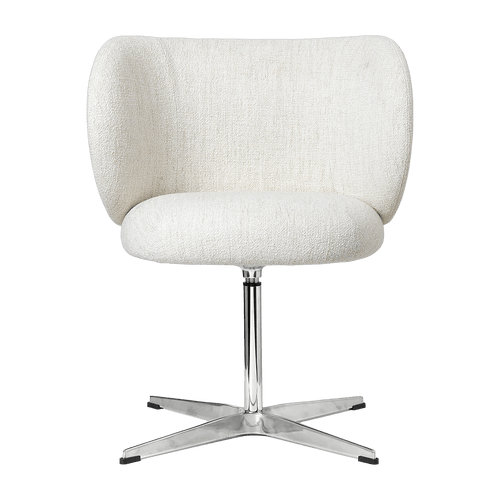
Ferm Living (Denmark) offers the Rico as a swivel office chair: 69 x 69 cm and 80 cm high, in white bouclé fabric or in black fabric, and a castored version in gold velvet. The Rico's wide seat suits those who tuck their legs onto the seat. See the brand Ferm Living.

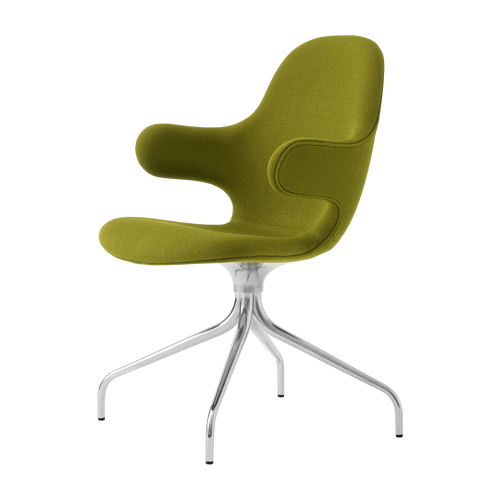
&tradition (Denmark) offers the Catch as an office chair: a polished aluminium structure, 58 x 58 cm and 90 cm high, in green fabric, in mustard fabric or in cognac leather. The Catch is aimed at a desk installed in a living space. See &tradition chairs.

VLUV brings together more than 50 ergonomic seats without a backrest, including the Leiv and Stov models, in 50, 60 or 70 cm. A VLUV seat is used as a complement to a chair with a backrest, to alternate seating positions during the day. See the brand VLUV.

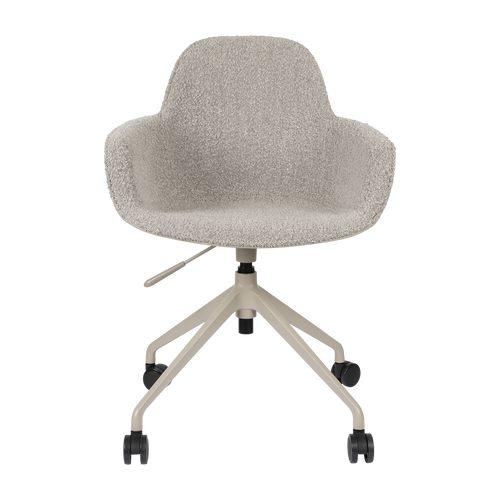
Zuiver (Netherlands) offers seven office chairs: the Albert Kuip in aluminium and polypropylene, with or without armrests, 84.4 cm high; the Nikki adjustable in brown or black leather, 77.5 cm high; the OMG adjustable in blue polyester, 76 cm high; the Doulton with castors, 79 cm high. See the brand Zuiver.

Black Muuto Fiber armchair on swivel base in front of a sea-green desk, in a bright studio
Muuto Fiber armchair on swivel base: the useful height of an office chair is that of the seat, not that of the backrest.

View the Ferm Living collection →

Practical examples

Daily remote work, 1.68 m, 74 cm desk

Target seat height: 44 to 48 cm, feet flat without a footrest. Eight hours a day require an adjustable seat, castors and armrests: a Swivel 5W from Normann Copenhagen or a Kendo from Hem. First adjust the height, then the armrests level with the desktop, and position the screen at arm's length. See the office chair collection.

A chair for a teenager's bedroom desk

The desk often measures 100 x 50 cm, against the wall: an adjustable chair without armrests that slides under the desktop and adapts to growth. The AAC 252 2.0 from HAY ticks all three boxes. A footrest is useful as long as the feet don't touch the floor once the seat is adjusted to elbow height. See the HAY chairs.

Alternate seating throughout the day

A chair with a backrest for long sessions, a VLUV seat of 60 or 70 cm for calls and reading, a standing break every hour: changing seating is the surest way to avoid remaining static. See the ergonomic office chair collection.

Woman leaning on two ergonomic VLUV seats shaped like balls, grey and blue, against a concrete wall
VLUV Stov, 60 cm in synthetic cement: a backless seat, to alternate with the chair during calls.

View the Office Chairs collection →

2026 Trends: What Our Customers Choose

What orders placed on The Cool Republic between January and September 2026 in the Office chairs collection show. Shares are counted by number of orders, not quantities, so that a large purchase carries no more weight than another.

The most requested brands

In order of orders: VLUV, Zuiver, Normann Copenhagen, Kartell.

The most ordered models since January

Method: orders placed on thecoolrepublic.com from 1 January to 30 September 2026, counted by number of orders containing the product; only models still on sale are listed. Survey updated quarterly.
View the Office Chairs collection →

The criteria that matter

The criteria that matter
CriterionWhat it changesReference figureThe pitfall
Adjustable seat height Elbows level with the desk, feet flat 42 to 52 cm depending on height (EN 1335-1 range approximately 40 to 51 cm) A fixed 45 cm chair in front of a 75 cm desk for a person 1.60 m tall
Backrest Lower back support Curved section at the small of the back, at belt height A straight, fixed backrest for eight hours of work
Armrests The weight of the arms, shoulder position Level with the desktop, or absent Fixed armrests higher than the desk: the chair no longer moves forward
Seat depth Contact with the backrest Three to four fingers between the edge and the back of the knee A seat that's too deep: you sit on the edge and your back no longer touches
Base Mobility and stability Five-branch castors for prolonged use Hard castors on a floor without a rug
Upholstery Thermal comfort and maintenance Breathable fabric, leather to condition, shell to wipe clean A bare shell without cushion for long days

Model comparison

Prices shown are the catalogue prices at the time you read this page.

Mistakes to avoid

  • Choosing a chair without height adjustment for a 72 to 75 cm desk: it will only suit one user height.
  • Adjusting the seat to desk height whilst forgetting about the feet: if they no longer touch the floor, add a footrest rather than lowering the chair.
  • Keeping armrests higher than the worktop: the shoulders rise and the chair can no longer move under the desk.
  • Sitting on the edge of a seat that is too deep: the back loses contact with the backrest; keep three to four fingers behind the knee.
  • Rolling hard castors on an unprotected parquet floor: the wood will mark within a few weeks.
  • Relying on the chair alone: without a break every hour, no seat will last an entire day.

Frequently asked questions

What is the best office chair?
The one that adjusts to your body and your desk: height-adjustable seat, backrest that supports the lower back, armrests level with the desktop or absent. For a full day, add castors on a five-star base. Then choose based on the seat, upholstery and style, ideally by trying it out.
What office chair is best for the back?
A chair whose backrest fits the curve of the lower back and whose seat adjusts to keep your feet flat and thighs horizontal. Lower back support matters more than total backrest height. No chair replaces breaks: stand up every hour, and consult a healthcare professional if you experience pain.
How to sit properly on an office chair?
At the back of the seat, with your back against the backrest, feet flat on the floor or on a footrest, thighs horizontal, elbows level with the desktop and shoulders relaxed. Place the screen at arm's length, its top edge at eye level. Then change position regularly and stand up at least once an hour.
How to adjust the backrest of an office chair?
Sit at the back of the seat. If the backrest adjusts in height, position its curved part at the small of your back, roughly at belt level. Then open the tilt slightly and, on a tilting mechanism, adjust the tension according to your weight: the backrest should follow your back without pushing or giving way.
What is the height of an office chair?
The seat of an office chair generally adjusts over a range of around ten centimetres; the EN 1335-1 standard provides for a range of approximately 40 to 51 cm, a reference to check depending on the type of seat. The right height places your elbows level with a desk of 72 to 75 cm, feet flat: 42 to 52 cm depending on your height.
How to lock an office chair?
To stop it rolling, choose castors with brakes, replace them with fixed glides of the same stem diameter or place a non-slip mat. To lock the height, release the lever under the seat: the gas lift locks. To prevent the backrest from tilting, lock it in the upright position if the mechanism allows.
How to raise an office chair?
Stand up slightly and pull the lever under the seat: the gas lift rises on its own. If the chair is already at its highest, a firm seat cushion gains a few centimetres, or the manufacturer offers a longer gas lift. Never dismantle a gas lift, it is under pressure. If the gap remains large, the desk may be too high.
What office chair for working from home?
Beyond four hours a day, a chair with an adjustable seat, on castors on a five-star base, with armrests level with the desktop: the Swivel 5W by Normann Copenhagen or the Kendo by Hem. For a few hours, a swivel design chair is sufficient and fits better in the living room, such as the Fiber by Muuto or the Maui by Kartell.