



Skip to content

-5% de remise supplémentaire sur tout notre OUTLET avec le code EXTRA5

Dès 150€ d’achats chez Serax, une carafe Fish&Fish est offerte. Ajoutez-la à votre panier !

BLACK MONTH Xmas Shop
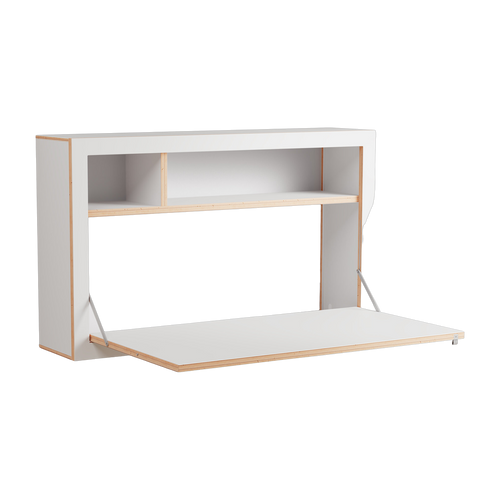
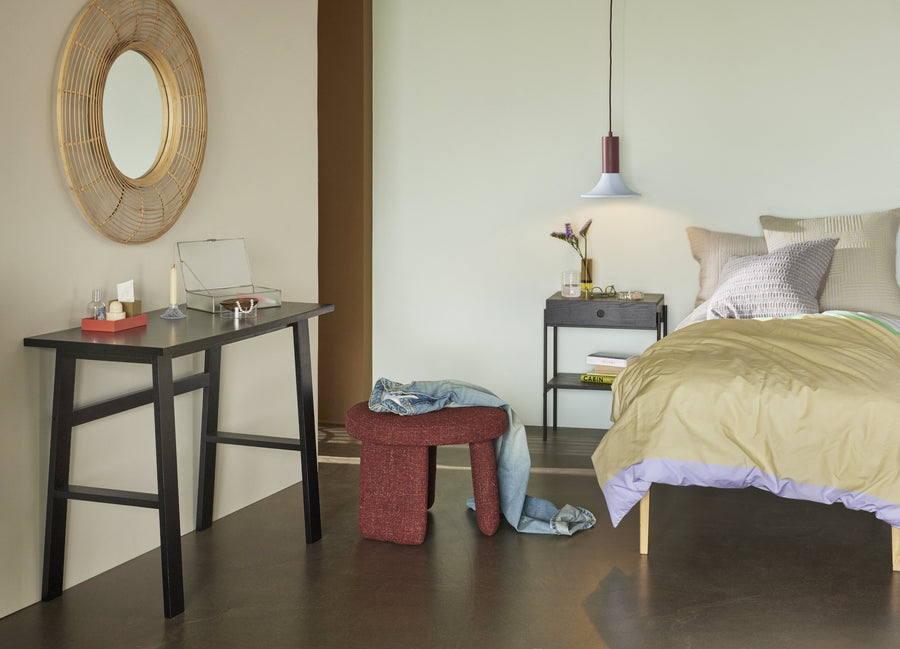
Hartô Gaston wall-mounted secretary desk in oak and ash green open in a bright bedroom, mustard pouf and linen bed

Buying guide

What height and dimensions for a desk?

A desk is chosen at the height of your elbows and the width of what you place on it: a laptop, a screen, two screens, papers. This guide gives the dimensions, compares twelve models from the catalogue and covers the cases of working from home, the bedroom and the wall-mounted desk.

12 models compared5 desk formatsupdated September 2026

Find your desk in 30 seconds

1 / 4

What will you use it for?

The number of screens determines the desktop width; the room determines the format.

How much wall space do you have?

Also allow 70 cm clearance behind the desk for the chair.

Which desktop appeals to you?

Wood develops a patina and can be sanded if solid; laminate resists stains and can be cleaned with a sponge.

What budget do you have in mind?

The desktop material and size account for most of the price difference.

Passer et lire le guide

Our recommendation

Deux alternatives sérieuses

Key takeaways

The standard height for a desk is 72 to 75 cm: the European standard EN 527-1 takes 74 cm as the reference for a fixed top, and most models in the catalogue adhere to it. Allow 120 x 60 cm for a laptop and a screen, 140 to 160 x 70 to 80 cm for two screens or daily home working, 80 to 100 x 45 to 60 cm in a bedroom.

  • Height: 72 to 75 cm for a fixed top; it's the chair that adjusts, elbows level with the surface.
  • Width: 120 cm for one screen, 140 to 160 cm for two screens or one screen and files.
  • Depth: 60 cm minimum, 70 to 80 cm as soon as an external screen is added, to keep it at arm's length.
  • In a bedroom or studio: 80 to 100 cm wide, or a wall-mounted desk that frees up floor space.
  • Behind the desk: 70 cm clearance for the chair, 90 to 100 cm if people pass behind you.

Dimensions to know

The dimensions in this section come from three sources, named in each case: the European standard EN 527-1, which governs the dimensions of office work desks, the dimensions written in the model titles of our desk collection, and ergonomic usage benchmarks, presented as such.

Desk height

The right height places the worktop level with your elbows when you are seated, shoulders relaxed and forearms horizontal. Too high, the worktop raises the shoulders and tires the neck by the end of the day; too low, it makes you lean forwards and rounds the back. On a fixed-height desk, you don't adjust the worktop: you adjust the chair to bring the elbows to the right level, then check that your feet rest flat on the floor.

Standard desk height

The standard is between 72 and 75 cm. The EN 527-1 standard takes 74 cm as a benchmark for a fixed-height worktop, and the catalogue titles confirm this: 74 cm for HAY's CPH, 73 cm for Ferm Living's Feve and Anonima Castelli's Platone, 75 cm for UMAGE's Heart'n'soul and Hübsch's Poke. This dimension suits the majority of adults, provided you have a height-adjustable chair.

Ideal desk height

It depends on your height, or more precisely on the height of your elbows in a seated position. Usage benchmark for an adjustable worktop: 66 to 70 cm between 1.55 and 1.65 m, 70 to 73 cm between 1.65 and 1.75 m, 73 to 77 cm between 1.75 and 1.85 m, 77 to 80 cm beyond. With a fixed worktop at 74 cm, a person of 1.60 m raises their chair and slides a footrest under the desk; a person of 1.90 m mainly checks the space for their knees under the worktop.

Desk dimensions

Three dimensions matter: the width, which determines what you place side by side, the depth, which sets the distance between your eyes and the screen, and the height. In depth, 45 to 50 cm are sufficient for a laptop alone; 60 cm is a minimum for a laptop and a keyboard; 70 to 80 cm allow you to place an external screen at arm's length, i.e. 50 to 70 cm from the eyes, a usage benchmark from ergonomists.

Desk width

Allow 80 to 100 cm for a laptop and a lamp, 120 cm for a screen, a keyboard and a notepad, 140 to 160 cm for two screens or a screen and open files alongside. Beyond that, a 180 cm worktop accommodates two people side by side or a drawing station. Also measure the footprint of objects that don't move: a floor lamp, a printer or a pedestal unit take up 20 to 40 cm of worktop.

Standard desk size

In manufacturers' catalogues, three formats recur: the compact of 100 to 120 x 50 to 60 cm, the standard of 120 to 140 x 60 to 70 cm and the large of 150 to 160 x 75 to 80 cm. The EN 527-1 standard takes as a benchmark a worktop of at least 120 x 80 cm for a complete office workstation; at home, a 120 x 60 cm worktop remains comfortable for a single screen.

Bedroom desk dimensions

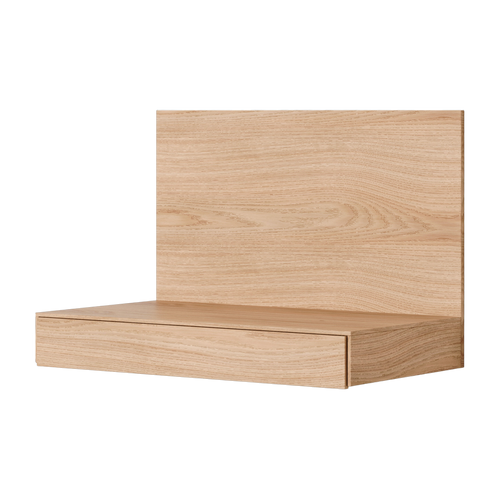
In a bedroom, aim for 80 to 100 cm wide by 45 to 60 cm deep, enough for a laptop, a lamp and notebooks. Hübsch's Poke measures 100 x 45 cm; Anonima Castelli's Platone, 83 x 65 cm, folds away. When floor space is lacking, a wall-mounted desk or a secretary frees up the floor: 80 x 50 cm for the small version of Ambivalenz's Fläpps Box, 80 x 32 cm for Hartô's Gaston. The table below summarises the dimensions by use.

Dimensions to know
UseWidthDepthHeightCatalogue example (dimensions of the item)
Laptop only, occasional desk 80 to 100 cm 45 to 60 cm 72 to 75 cm Poke, Hübsch: 100 x 45 x 75 cm
Laptop and one screen 120 cm 60 to 70 cm 72 to 75 cm Feve, Ferm Living: 117 x 60 x 73 cm
One screen and files 130 to 140 cm 65 to 80 cm 72 to 75 cm CPH90, HAY: 130 x 65 x 74 cm
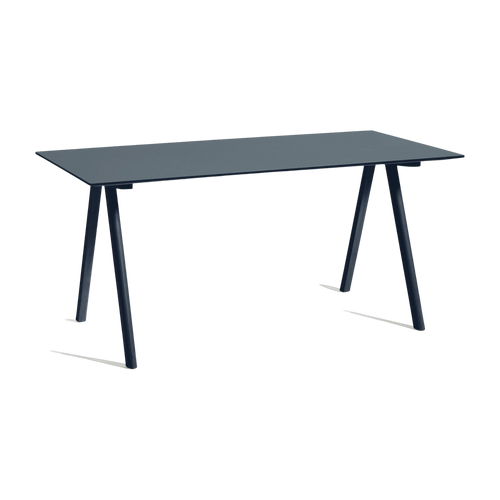
Two screens, daily working from home 150 to 160 cm 75 to 80 cm 72 to 75 cm CPH 10 2.0, HAY: 160 x 80 x 74 cm
Two people side by side 180 cm and over 80 to 90 cm 72 to 75 cm Works, String Furniture: 180 x 90 cm top
Bedroom wall-mounted desk 80 to 100 cm depending on the model 72 to 75 cm when installed Fläpps Box, Ambivalenz: 100 x 60 x 20 cm

Calculation rule: worktop at seated elbow height; 72 to 75 cm for a fixed surface; width = what you place side by side (120 cm for one screen, 160 cm for two); depth of 70 to 80 cm as soon as an external screen is added.
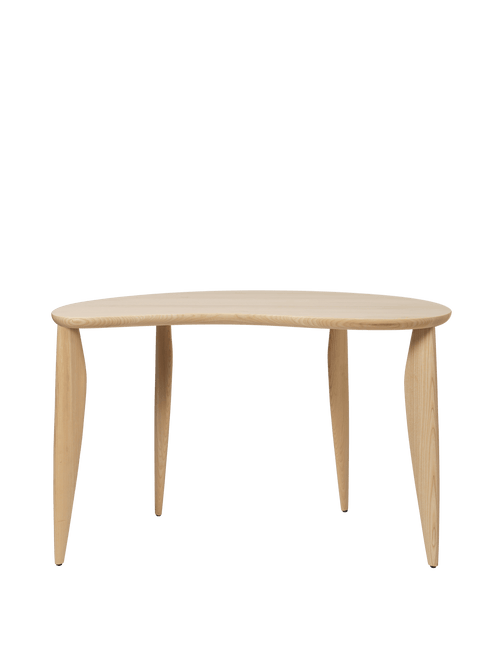
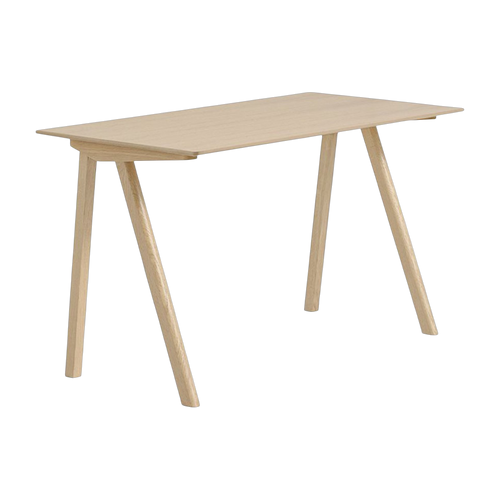
UMAGE Heart'n'soul desk in oak in front of a curtained window, office chair with castors and open laptop
UMAGE Heart'n'soul: 120 × 80 cm at 75 cm high, a deep top that keeps the screen at a good distance from the eyes.

View the Desks collection →

Chair, screen, legs: adjusting your workstation around the desk

The chair adjusts the height

With a fixed-height top, the chair does the work: seat adjusted so that the elbows reach the level of the top, feet flat, thighs horizontal or slightly inclined downwards. If the feet no longer touch the floor once the chair is raised, a footrest fills the gap. Chairs with adjustable seats are brought together in the office chair collection, and our office chair guide details the adjustments one by one.

The screen at arm's length

Rule of thumb: the top of the screen at eye level or just below, 50 to 70 cm away. It's this distance that determines the depth of the desk: a 60 cm top requires moving the screen closer to the edge, an 80 cm top leaves it at the back and frees up space for the keyboard. For a laptop used all day, a stand that raises the screen and a separate keyboard avoid working with your head down. Deep tops are in the wooden desk collection.

Leg room

Under the top, you need to be able to cross your legs and move your feet: avoid low crossbars and pedestals placed where your knees go. A desk with drawers houses its storage under the top, over a few centimetres of thickness: check that there's enough free height above your thighs once the chair is adjusted. Models with integrated storage are in the desk with storage collection.

The clearance behind the desk

Allow 70 cm between the edge of the desk and the wall or furniture behind you to pull back the chair, 90 to 100 cm if someone passes behind you. In a bedroom, it's often this clearance, not the size of the top, that decides where to place the desk: facing a wall, at the end of the bed or in the corner of the room. Compact models are in the desk collection.

HAY CPH90 desk in oak with a black office chair on castors, in a room with painted brick walls and wooden ceiling
HAY CPH90: 130 × 65 cm at 74 cm; with a fixed-height top, the chair is adjusted to bring the elbows level with the top.

View the Office Chairs collection →

Straight desk, desk with drawers, wall-mounted desk, folding desk or modular desk: which format for which room
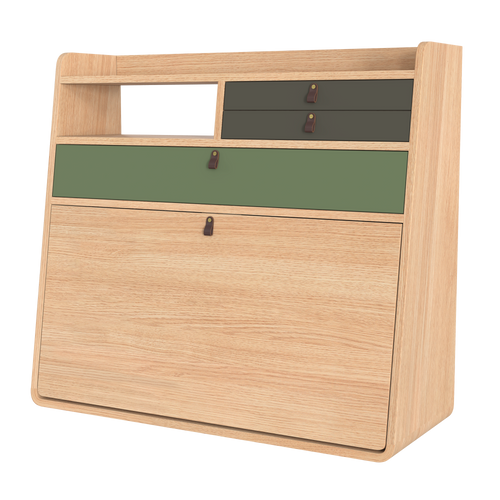
The straight desk with legs

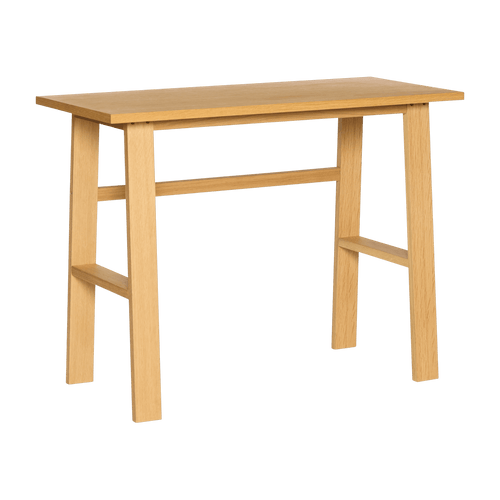
A worktop on four legs or on two trestles: this is the format that leaves the most legroom and is the easiest to move. Fine lines and light woods lighten a desk installed in the living room; the New Modern from TIPTOE comes in several leg colours, black, cream white, pale blue or eucalyptus grey. See the collection of Scandinavian desks.

The desk with drawers

One or two drawers under the worktop keep chargers, notebooks and pens out of sight, which matters when the desk lives in the living room. The My Writing Desk from EMKO is available with one or two drawers, the 4.9 Drawers in 80 and 140 cm, the New Modern from TIPTOE in 130 x 70 cm with drawers. See the collection of desks with storage.

The wall-mounted desk and the secretary

Fixed to the wall, it doesn't touch the floor: this is the answer for bedrooms, hallways and studios. Widths range from 60 to 130 cm: Gaston from Hartô in 60 or 80 cm, Fläpps from Ambivalenz in 80 x 50 or 100 x 60 cm, Tana from New Works in 85 cm, or 130 cm with drawers. Install it at the same height as a classic desk, 72 to 75 cm, and check the nature of the wall before drilling. See the collection of wall-mounted desks.

The folding desk

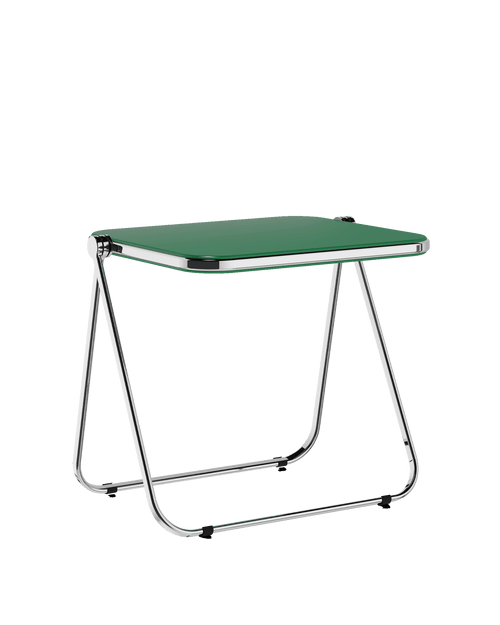
The Platone from Anonima Castelli, 83 x 65 x 73 cm, folds away when not in use: an extra workstation for the guest room or living room, in matt steel, in six colours. Moebe and Woodendot also offer folding wall-mounted desks that fold back against the wall. See the collection of desks.

The modular desk

String Furniture combines worktop, uprights and shelves in specified configurations from 80 x 115 x 58 cm to 140 x 200 x 96 cm, and also sells its Works worktops separately, from 120 x 78 cm to 180 x 90 cm. A format that evolves with needs: you add a shelf, you change the worktop. See the collection of String Furniture desks.

New Works Tana wall-mounted desk in oak fixed to the wall, open drawer, table lamp and wooden chair
New Works Tana: a 47 x 85 cm wall-mounted oak desk, fixed to the wall, which doesn't touch the floor.

View the Wall desks collection →

Oak, walnut, laminate, linoleum or steel: what the tabletop changes

Solid wood and veneer

Oak, walnut, ash: the wooden top develops a patina, marks under a pressed pen tip and can be sanded down if it is solid. A veneer, a thin sheet of wood glued to a panel, is more stable and lighter, but must be sanded with care. Place a desk mat under the mouse and keyboard: this is where the finish wears first. See the wood desk collection.

Laminate and linoleum

Laminate, chosen by TIPTOE for the New Modern and by String Furniture for its Works tops, resists everyday stains and scratches and can be cleaned with a sponge. Linoleum, which HAY uses on its CPH 2.0, offers a matt, soft surface under the forearms, pleasant for writing; it is maintained with a neutral, solvent-free product. See the HAY desks and tables.

Steel

Slim top, lightweight structure, bold colours: Tolix's Clapet, in 105 or 130 cm, and Metallbude's Donna have the look of a workshop piece. Lacquered steel is resistant to water and hot mugs, but scratches on contact with metal objects: a desk mat solves the problem. See the black desk collection.

Rounded light ash top of the Ferm Living Feve desk, with a pencil pot, a leather box and a vase
Ferm Living Feve, tray in natural ash 117 x 60 cm: the wood develops a patina; a desk mat under the mouse and keyboard protects the finish.

View the Wooden Desks collection →

Lighting the Office

Place the desk perpendicular to the window: light arrives from the side, with no reflections on the screen or backlighting behind you. In the evening, a desk lamp provides the 500 lux on the work surface that standard NF EN 12464-1 recommends for reading, writing and working on a screen in an office. Position it on the left if you write with your right hand, on the right if you're left-handed: the shadow of your hand won't fall on the page. Models are in the desk lamp collection, and our room-by-room lighting guide provides guidelines for the whole home.

TIPTOE New Modern desk in oak on black legs, with a black desk lamp, a laptop and a pencil pot
TIPTOE New Modern, 150 x 70 cm: in the evening, a desk lamp lights the worktop; place it on the opposite side to your writing hand.

View the Desk Lamps collection →

Which desk brand to choose

HAY (Denmark) publishes the CPH series, designed by Ronan and Erwan Bouroullec: 130 × 65 cm or 160 × 80 cm, at 74 cm, in lacquered oak, with a linoleum top on the 2.0 versions. The 140 cm Passerelle completes the range. See the brand HAY.

Normann Copenhagen (Denmark) offers the Kip, a 150 × 75 cm top in oak or pine, and the Journal in white or black laminate. See the brand Normann Copenhagen.

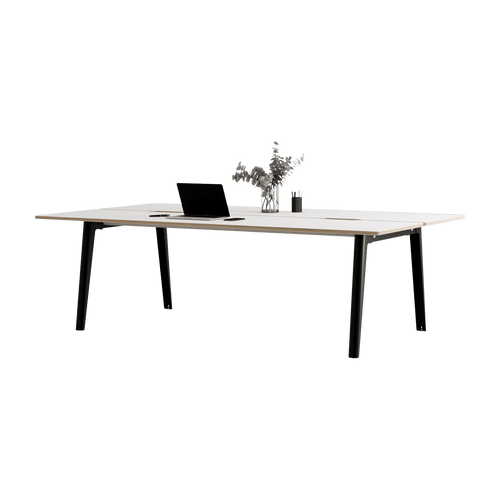
TIPTOE (France) offers the New Modern in 130 or 150 × 70 cm, in eco-certified oak, laminate or recycled plastic, with or without drawers, and in open-space desks up to 280 × 140 cm for working together. See the brand TIPTOE.

String Furniture (Sweden) builds modular desks on its shelf uprights and sells its Works tops from 120 to 180 cm. See the String Furniture desks.

Ferm Living (Denmark) designs the Feve in ash or walnut, 117 cm wide, the Tarn in beech and the Edre in pine at 137 × 65 cm. See the brand Ferm Living.

UMAGE (Denmark) offers the Heart'n'soul at 120 × 80 × 75 cm, in oak or walnut, a deep top for a screen. See the brand UMAGE.

Large TIPTOE desk in white laminate on black legs, in a white room, with a laptop and a bouquet
TIPTOE New Modern open-space: 240 x 140 cm white laminate on black legs, for two workstations facing each other.

View the Scandinavian Desks collection →

Practical examples

Working from home three days a week in a 25 m² living room

Two screens won't fit on 120 cm; one screen and a laptop will. A 130 x 65 cm top like HAY's CPH90, at 74 cm high, accommodates the screen at the back, the open laptop next to it and a notebook. With 70 cm clearance for the chair, the whole setup takes up around 130 x 135 cm of floor space. If the desk needs to disappear at the weekend, a 100 x 60 cm wall-mounted desk like Ambivalenz's Fläpps Box takes over. See the wooden desk collection.

A student desk in a 10 m² bedroom

The available space is often a 100 cm stretch of wall between the wardrobe and the bed. A 100 x 45 cm top like Hübsch's Poke, at 75 cm high, is enough for a laptop, a lamp and notebooks. Add a chair without armrests, which slides completely under the top, and an adjustable-arm desk lamp, placed on the side opposite the writing hand. See the desk collection.

Two people working together at home

Side by side, each needs a minimum of 80 cm width, 100 cm with a screen. A 180 x 90 cm top like String Furniture's Works, or a 240 x 140 cm open-plan desk like TIPTOE's New Modern, whose depth allows sitting face to face, gives each person their own zone without a partition. See the TIPTOE brand.

Ferm Living Feve desk in ash in a corner of a living room, swivel armchair in ecru bouclé, curtains and painting on the wall
Ferm Living Feve, 117 x 60 x 73 cm: a desk with a light appearance for a corner of the living room, with a laptop or a screen.

View the Desks collection →

Trends 2026: what our customers are choosing

What orders placed on The Cool Republic between January and September 2026 show in the Desks collection. Shares are counted by number of orders, not quantities, so that a large purchase does not weigh more than another.

The most requested brands

In order of orders: Hübsch, Ferm Living, String furniture, Hartô.

The most ordered models since January

Method: orders placed on thecoolrepublic.com from 1 January to 30 September 2026, counted by number of orders containing the product; only models still on sale are listed. Data updated quarterly.

View the Desks collection →

The criteria that matter

The criteria that matter
CriterionWhat it changesFigure to rememberThe pitfall
Worktop height The position of the shoulders and back 72 to 75 cm for a fixed top (EN 527-1 standard: 74 cm) An 80 cm desk without an adjustable chair: shoulders hunched up all day
Width What you place side by side 120 cm for one screen, 140 to 160 cm for two Two screens on 120 cm: one of them ends up at an angle
Depth The distance between the eyes and the screen 60 cm minimum, 70 to 80 cm with an external screen A large screen on 50 cm depth: too close to the eyes
Space under the worktop Leg room No crossbar or pedestal at knee height A fixed pedestal where your legs go
Space behind the desk Standing up, pulling back the chair 70 cm; 90 to 100 cm if you walk behind A desk placed 50 cm from the bed: the chair no longer pulls back
Worktop material Maintenance and feel Wood to protect with a desk mat; laminate and linoleum easy to live with A varnished top without a mat under the mouse

Model comparison

Prices shown are the catalogue prices at the time you read this page.

Mistakes to avoid

  • Buying an 80 cm high desk without an adjustable chair: shoulders rise and the neck tires; 72 to 75 cm suits most adults.
  • Placing two screens on a 120 cm worktop: one ends up at an angle; allow 140 to 160 cm in width.
  • Choosing 50 cm depth to work on an external screen: it remains too close to the eyes; 70 to 80 cm puts it at arm's length.
  • Positioning the desk 50 cm from a bed or wardrobe: the chair no longer moves back; leave 70 cm behind the worktop.
  • Placing the screen facing the window or with your back to it: reflections on one side, backlighting on the other; the desk should be perpendicular to the window.
  • Fixing a wall-mounted desk without knowing the wall: a plasterboard partition requires wall plugs suited to the load.

Frequently asked questions

What is the standard height of a desk?
Between 72 and 75 cm. European standard EN 527-1 takes 74 cm as the reference for a fixed-height work surface, and most manufacturers adhere to it: 74 cm for HAY's CPH desks, 73 cm for Ferm Living's Feve, 75 cm for UMAGE's Heart'n'soul. The chair, being adjustable, then completes the adjustment to your height.
What is the ideal desk height according to your height?
The one that places the desktop at the level of your elbows, seated, forearms horizontal. Rule of thumb: 66 to 70 cm for heights between 1.55 and 1.65 m, 70 to 73 cm up to 1.75 m, 73 to 77 cm up to 1.85 m, 77 to 80 cm beyond. On a fixed desk, adjust the chair and add a footrest if needed.
What are the standard dimensions of a desk?
Three formats recur among manufacturers: compact, 100 to 120 x 50 to 60 cm; standard, 120 to 140 x 60 to 70 cm; large, 150 to 160 x 75 to 80 cm, all 72 to 75 cm high. Compact suits a laptop, standard suits a screen, large suits two screens or daily remote working.
What desk width should I choose?
Add up what you place side by side: 80 to 100 cm for a laptop and lamp, 120 cm for a screen and keyboard, 140 to 160 cm for two screens or a screen and open files, 180 cm and above for two people. Add 20 to 40 cm if a desk lamp or printer remains on the desktop.
What desk size for a bedroom?
80 to 100 cm wide and 45 to 60 cm deep is sufficient for a laptop, lamp and notebooks. Allow 70 cm clearance for the chair. If floor space is lacking, a wall-mounted desk or secretary desk, 60 to 100 cm wide, fixes at 72 to 75 cm from the floor and frees up the room.
What desk size for two screens?
At least 140 cm wide, 160 cm for two large screens placed side by side, and 75 to 80 cm deep to keep them 50 to 70 cm from your eyes. HAY's CPH 10 2.0, 160 x 80 x 74 cm, and Normann Copenhagen's Kip, 150 x 75 cm, meet this specification.
How do I know if my desk is too high?
Sit down, shoulders relaxed, forearms horizontal: if the desktop is above your elbows, it is too high, and your shoulders rise when you type. Then raise the chair until your elbows are level with the desktop, then slide a footrest under your feet if they no longer touch the floor.