



Skip to content

-5% de remise supplémentaire sur tout notre OUTLET avec le code EXTRA5

Dès 150€ d’achats chez Serax, une carafe Fish&Fish est offerte. Ajoutez-la à votre panier !

BLACK MONTH Xmas Shop
Tableclothed table against a green wall, Nude Glass Refine wine glasses served with red and white wine, carafe on a golden tray

Buying guide

Which wine glass to choose, and which tableware for entertaining?

A wine glass is chosen by the size of its bowl, a plate by its diameter and material, cutlery by its steel. This guide gives the capacities and diameters listed in the catalogue, compares twelve wine glasses and answers practical questions about the table, right down to the bin for the broken plate.

12 wine glasses compared10 table formatsupdated September 2026

Find your glassware and tableware in 30 seconds

1 / 4

What are you looking for?

Large bowl for red wine, smaller for white, flute for sparkling.

For which table?

A thick rim withstands the dishwasher better; fine, colourless glass is reserved for meals where one takes one's time.

Transparent or coloured?

Colourless glass lets you judge the colour of the wine; tinted glass and coloured stoneware dress the table.

What budget do you have in mind?

The price is per set or per unit, depending on the product title.

Passer et lire le guide

Our recommendation

Deux alternatives sérieuses

Key takeaways

For red wine, a large-bowled glass of 450 to 790 ml, filled one-third; for white, a smaller glass of 320 to 360 ml, filled half at most; for champagne, a flute of 18 to 24.5 cl. For tableware, allow per guest one dinner plate of 26 to 28 cm, one soup plate of 22 to 23 cm and one dessert plate of 20 cm.

  • Red wine glass: 450 to 790 ml, filled one-third; Bordeaux for full-bodied reds, Burgundy for delicate reds.
  • White wine glass: 320 to 360 ml, filled half at most to keep the wine chilled.
  • Carafe: 75 cl minimum, 1.5 l for a magnum; narrow neck for decanting, wide base for aerating.
  • Plates per guest: dinner plate 26 to 28 cm, soup plate 22 to 23 cm, dessert plate 20 cm.
  • Cutlery: 18/10 stainless steel for durability; 4 pieces per guest in a cutlery set.

Capacities and diameters to know

No standard defines the capacity of a wine glass or the diameter of a plate: the ranges below are those observed in the model titles in the catalogue, supplemented by usage benchmarks named as such. All the models mentioned are in our tableware collection.

What capacity wine glass

The red wine glasses in the catalogue range from 450 to 790 ml (Nude Glass Vinifera 450 and 790 cc, Terroir 590 and 670 cc, Refine 610 cc, Libellule by Serax 78 cl); white wine glasses, from 320 to 360 ml (Nude Glass Refine 320 cc and Vinifera 360 cc, Nordal Opia 360 ml). This volume is not what you pour: as a usage benchmark, a red wine glass is filled to about one-third, up to its widest part, and a white wine glass to half at most. The space above the wine captures the aromas that you smell as you bring the glass closer. For reference, the 'standard glass' in public health campaigns corresponds to 10 cl of wine.

Wine glass water glass size

In French table service, the water glass is the largest or widest of the glasses placed in front of the plate, followed by the red wine glass, then the white wine glass. In the catalogue, water glasses range from 20 cl (Ripple by Ferm Living) to 35 cl (Surface by Serax), most without a stem. If you only buy one set, a stemmed glass of 350 to 450 ml serves water, white wine and red wine for everyday use, like the versatile Terroir glasses by Nude Glass.

Crystal carafe size

Two questions lie behind this query. Size, first: a wine carafe holds at least one bottle, i.e. 75 cl, and 1.5 l for a magnum (Cantina Magnum by Nude Glass); there still needs to be space above the wine to aerate it. Cut crystal, second: crystal whose surface is engraved with wheel-cut facets that catch the light. The term crystal is regulated and requires, for lead crystal, a minimum lead oxide content; the catalogue titles refer to lead-free crystal (Nude Glass) and crystalline glass (Anna + Nina).

Plate diameter

In the catalogue, the dinner plate or flat plate measures 26 to 28 cm (Silhouette by Serax 26 cm, Flow by Ferm Living 27 cm, HKliving 27.5 cm, Amare by Hübsch 28 cm); the starter plate 22 to 23 cm; the dessert plate 17.5 to 20 cm; the soup plate 21.5 to 23 cm; the bread plate 15 cm. Measure the inside of your cupboards and dishwasher before choosing a 28 cm plate or larger: some racks do not accept large diameters.

Standard plate size

There is no single size: the standard in use is a trio. A 26 to 27 cm flat plate, a 22 to 23 cm soup plate, a 20 cm dessert plate per person. This is the composition of the 12-piece sets in the catalogue, which serve four people with three plates each (Cena and La Mère by Serax). The plates are in our plate collection.

Capacities and diameters to know
ItemRange observed in catalogueModels (title dimensions)
Red wine glass 450 to 790 ml Nude Glass Vinifera 450 and 790 cc, Terroir 590 and 670 cc, Refine 610 cc; Serax Libellule 78 cl
White wine glass 320 to 360 ml Nude Glass Refine 320 cc, Vinifera 360 cc; Nordal Opia 360 ml
Flute or champagne glass 18 to 24.5 cl &Klevering Curve and Perle 18 cl; Nordal Opia 200 ml; Nude Glass Vinifera 245 cc
Water glass 20 to 35 cl Ferm Living Ripple 20 cl; Serax Surface 35 cl
Wine carafe 75 cl and above Nude Glass Vintage 750 cc; &tradition Collect 0.8 and 1.2 L (glass carafes)
Dinner plate 26 to 28 cm Serax Silhouette 26 cm; Ferm Living Flow 27 cm; HKliving 27.5 cm; Hübsch Amare 28 cm
Starter plate 22 to 23 cm Serax Silhouette 23 cm; HKliving 22 cm; Serax Cena 22 cm
Dessert plate 17.5 to 20 cm HKliving 17.5 cm; Pomax 20 cm; Broste Copenhagen Nordic Vanilla 20 cm
Soup plate 21.5 to 23 cm Serax Silhouette 21.5 cm; Broste Copenhagen Nordic Sand 22.5 cm; Hübsch Amare 23 cm
Bread plate 15 cm Ferm Living Flow 15 cm; Serax Dunes 15 cm

Usage guideline for serving: red wine glass filled one-third, white wine glass half-full at most, flute two-thirds full. Per guest: one dinner plate, one soup plate, one dessert plate, one water glass and one or two wine glasses.
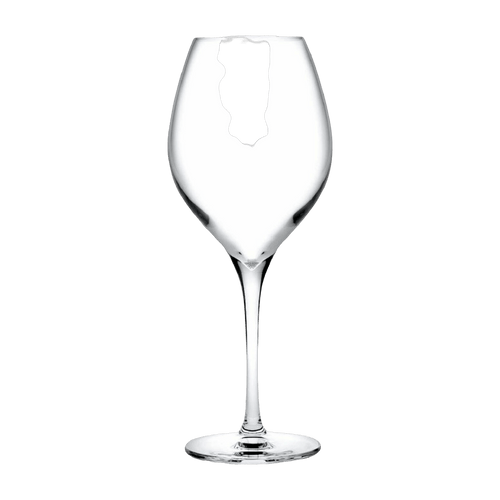
Nude Glass Refine red wine glass served on a wooden table with a bottle and a bowl of grapes
Nude Glass Refine, 610 cc: this volume is not the amount to be served; a red wine glass is filled to about one third.

View the Wine Glasses collection →

Which glass for which wine

Which wine glass to choose

Three criteria matter more than the brand. The bowl: the wider it is, the more the wine breathes and releases its aromas; the more it narrows at the top, the more it concentrates them towards the nose. The fineness of the rim: a thin rim goes unnoticed on the lips, a thick rim withstands the dishwasher and knocks better. The stem: it prevents warming the wine with your hand and allows you to swirl it. A transparent and colourless glass lets you judge the wine's colour; smoked, frosted or tinted glasses (Ripple by Ferm Living, Swirl by HKliving, Tint by HAY) are table glasses rather than tasting glasses.

The red wine glass: Bordeaux or Burgundy

The Bordeaux glass is tall, with an elongated and slightly tapered bowl: it suits full-bodied reds, directing the wine towards the middle of the tongue. The Burgundy glass is a wide and rounded balloon, which exposes a large surface to the air: it serves fine and aromatic reds. Nude Glass produces both shapes in its Vintage and Pure ranges, and a Grand Burgundy for the finest wines. For a single set of red wine glasses, a bowl of 450 to 600 ml, between the two shapes, covers most wines.

The white wine and rosé glass

Smaller, from 320 to 360 ml in the catalogue, the white wine glass keeps the wine cool longer: it is served in small quantities, which are refilled. However, a full-bodied and oaked white tolerates a wider glass, close to the Burgundy (Nude Glass produces a Burgundy for white wine). Rosé is served in a white wine glass or in a dedicated glass, such as the Vintage rosé glass by Nude Glass.

Flute, coupe or champagne glass

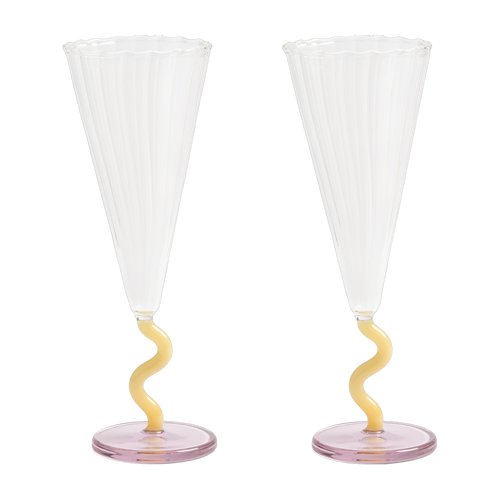
The flute, tall and narrow, makes the bubbles rise in a column and preserves them; the coupe, wide and flared, has the charm of the 1930s but lets bubbles and aromas escape; the tulip champagne glass, between the two, is gaining ground at the table, as it also lets you smell the wine. In the catalogue, flutes range from 18 cl (&Klevering) to 24.5 cl (Nude Glass Vinifera), and Ferm Living offers its Ripple range in flutes and coupes. See the collection of flutes and champagne glasses.

How to choose a wine glass: the case for a universal glass

If space is limited, a single set of stemmed glasses of 350 to 450 ml, with a tulip-shaped bowl, serves red, white, rosé and even sparkling wines. This is the principle of versatile glasses, such as the Terroir set by Nude Glass. Complete later with larger red wine glasses if you often serve fine wines. All models are in our wine glass collection.

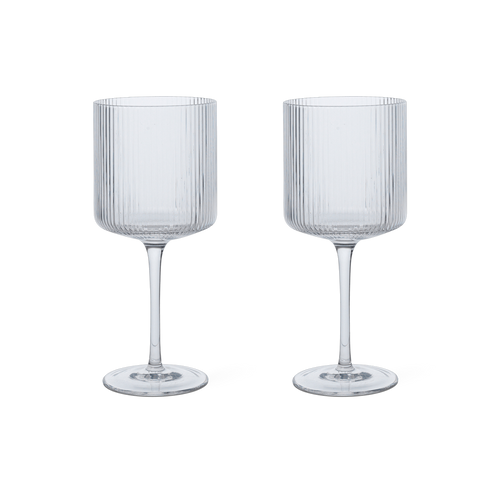
Two Ferm Living Ripple wine glasses in ribbed glass, one served with red wine, next to a bottle and a loaf of bread
Ferm Living Ripple, 7.9 × 18.2 cm: a ribbed red wine glass, for everyday table use rather than wine tasting.

View the Wine Glasses collection →

Which glass for which grape variety

Choosing a wine glass by grape variety follows a simple logic: the structure of the wine determines the shape of the bowl. The correspondences below are practical guidelines, shared by glassmakers and sommeliers, not a standard.

Which glass for a Cabernet Sauvignon, Merlot or Syrah

A Cabernet Sauvignon, Merlot or Syrah produces tannic, structured red wines. These red wines are served in a Bordeaux glass, tall, with an elongated bowl. Nude Glass produces this shape in a set of 2 in the Vintage series and in a set of 4 in the Pure series.

Which glass for a Pinot Noir or Gamay

A Pinot Noir or Gamay produces fine, low-tannin red wines, carried by their aromas. These red wines require a Burgundy glass, with a wide balloon shape. Nude Glass produces the Burgundy glass in a set of 2 (Vintage), in a set of 4 (Pure) and in a Grand Burgundy version.

Which glass for a Chardonnay, Sauvignon or Riesling

A barrel-aged Chardonnay, full-bodied and oaky, supports a wide bowl: the Burgundy glass for white wine from the Vintage series by Nude Glass. A Sauvignon, Riesling or Chenin, lively and aromatic, keeps its freshness in a narrower white wine glass, from 320 to 360 ml, such as the Refine 320 cc or the Vinifera 360 cc by Nude Glass.

Do you need one glass per grape variety

No. Two series cover most bottles: a Bordeaux glass for structured reds and a white wine glass. Add a Burgundy glass if you often serve Pinot Noir. The shapes mentioned are in the wine glass collection.

Which glass for which grape variety
Grape variety or wine typeGlass shape (usage guide)Model in the catalogue
Cabernet Sauvignon, Merlot, Syrah Bordeaux glass, tall and elongated Nude Glass Vintage, set of 2 Bordeaux glasses; Nude Glass Pure, set of 4 Bordeaux glasses
Pinot Noir, Gamay Burgundy glass, wide bowl Nude Glass Vintage, set of 2 Burgundy and Grand Burgundy glasses; Nude Glass Pure, set of 4 Burgundy glasses
Oak-aged Chardonnay Burgundy glass for white wine Nude Glass Vintage, set of 2 Bourgogne White glasses
Sauvignon, Riesling, Chenin Narrow white wine glass, 320 to 360 ml Nude Glass Refine 320 cc; Nude Glass Vinifera 360 cc
Rosé White wine glass or rosé glass Nude Glass Vintage, set of 2 rosé wine glasses
Champagne, Crémant Flute or tulip glass, 18 to 24.5 cl Nude Glass Vinifera 245 cc; &Klevering Curve 18 cl

Rule of thumb: tannic red wine, Bordeaux glass; delicate red wine, Burgundy glass; crisp white wine, narrow glass of 320 to 360 ml; oaky white wine, wide bowl.

Nude Glass Cantina wine carafe with wide base filled with red wine, wine glass and cheese platter
Nude Glass Cantina: a carafe designed for magnums, with a wide base that spreads the wine to aerate it.

View the Wine Glasses collection →

Wine carafe, decanter, water carafe
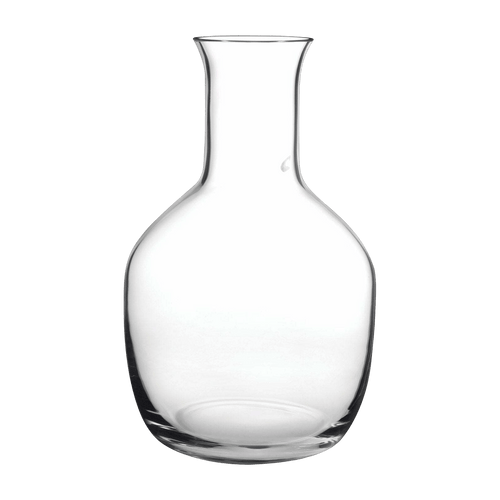
How to choose a decanting carafe?

Decanting and aerating are two different actions. Decanting means gently transferring an aged wine to leave its sediment in the bottle: you need a simply shaped carafe with a fairly narrow neck, in which the wine doesn't swirl too much. Aerating means exposing a young, closed wine to air: you need, on the contrary, a carafe with a wide base that spreads the wine over a large surface. In both cases, the capacity should exceed 75 cl for one bottle, and reach 1.5 l for a magnum.

Which wine carafe to choose

For everyday use, a wine carafe of at least 75 cl, in transparent and colourless glass to see the wine's colour, with a wide base to aerate it, and stable enough to be placed on the table. The Vintage wine carafe by Nude Glass (750 cc) and the Cantina Magnum for large formats meet these criteria; the Ripple wine carafes by Ferm Living are available in transparent, smoked or frosted glass. Also check the opening: a neck the width of a hand is easy to clean, a narrow neck requires beads or a special brush.

The water carafe

Taller than it is wide, often with a spout, a stopper or an upturned glass as a lid: this is the carafe for the everyday table and the bedside table. In the catalogue, they range from 0.5 l (Monsieur Cruchot by Serax) to 2 l (Glass Jug by HAY, in borosilicate glass that withstands hot water), via 85 cl (Fish&Fish by Serax) and 1 l (Dimple by Ferm Living). The carafes are in our collection of carafes and pitchers and the glass carafe collection.

Nude Glass Cantina wine carafe with wide base filled with red wine, wine glass and cheese platter
Nude Glass Cantina: a carafe designed for magnums, with a wide base that spreads the wine to aerate it.

View the Carafes and Jugs collection →

Decanting or aerating wine: the steps

Aerating a young red wine and decanting an aged red wine require two opposite approaches. Here is the order of operations for each, from decanter to glass.

How to aerate a young red wine in a decanter

  1. Choose a wine decanter with a wide base, with a capacity greater than 75 cl for one bottle.
  2. Rinse the decanter with plain water, without any product, and drain it: a smell of washing-up liquid or cupboard passes into the wine.
  3. Pour the wine decisively, along the side of the decanter, so that it spreads out and takes in air.
  4. Taste the wine at regular intervals. No duration applies to all wines: the wine is ready when its nose opens up and its tannins seem softer.
  5. Serve in a red wine glass filled to one-third, up to the widest part of the bowl.

How to decant an aged red wine

  1. Stand the bottle upright several hours before the meal, the day before if possible: the sediment settles at the bottom.
  2. Take a decanter with a simple shape, with a fairly narrow neck, which limits the wine's contact with air.
  3. Pour slowly, in one go and without standing the bottle upright, with the shoulder of the bottle placed in front of a light source.
  4. Stop pouring as soon as the sediment reaches the neck. Some wine remains at the bottom of the bottle, this is normal.
  5. Serve without delay: an aged wine loses its freshness quickly once in the decanter.

Should you decant a white wine or a champagne

A young, closed white wine sometimes benefits from being put in a decanter, like a young red wine. Champagne is not decanted in common practice: being put in a decanter makes it lose some of its bubbles. Wine decanters are in the collection of decanters and jugs.

Young wine: wide-bottomed decanter, bold pour, taste before serving. Aged wine: narrow-necked decanter, slow pour, serve immediately.

Serax Surface cutlery in grey steel laid on a white tablecloth: knives, forks and spoons
Serax Surface: a 24-piece set in grey steel, a complete cutlery set for six people.

View the Carafes and Jugs collection →

Plates: material, format and set composition
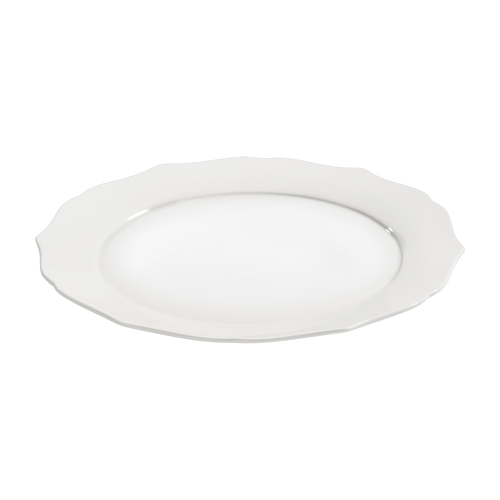
Plate which material to choose

The porcelain is fine, white, non-porous and resistant: without metallic decoration, it is generally dishwasher and microwave safe (in the catalogue, Silhouette and Cena by Serax, Flow by Ferm Living). Stoneware is thicker, vitrified throughout, robust, with a handcrafted finish (La Mère and Inku by Serax, Nordic Sand by Broste Copenhagen, the 70's tableware by HKliving). Earthenware is a porous clay covered with enamel, more fragile to knocks, often decorated (Anna + Nina). Terracotta (Barro by HAY) and stone powder (Amare by Hübsch) give matt and warm pieces. Stainless steel (Tumbled by Ferm Living, Essentiel by HAY) is unbreakable, for outdoors and children. Wood (Dunes by Serax, in acacia) is hand washed.

Which plate for microwave

Porcelain and stoneware without metallic decoration, and tempered glass. Never plates with metallic decoration, gold or silver trim, nor metal, nor wood. Crazed earthenware and terracotta can absorb water and heat unevenly. In all cases, the pictogram printed under the plate is definitive.

Which plate to serve couscous in

In a wide soup plate, 22 to 25 cm, which holds the semolina, vegetables and broth without overflowing: the 25 cm soup plate from La Mère by Serax or the 22.5 cm Nordic Sand by Broste Copenhagen. To serve in the centre of the table, a large soup plate such as the 32 cm Inku soup plate by Serax.

Building up a dinner service

Allow three plates per guest (dinner, soup, dessert), plus a few bread or starter plates if you entertain often. A six-place setting therefore consists of eighteen plates; a twelve-place setting, thirty-six. Plan for two extra pieces per series to replace breakages, especially if the collection is handcrafted: the enamel and shade vary from one production to another. You can also deliberately mismatch, keeping the same material or the same dominant colour. See the collection of stoneware plates and the collection of white plates.

Serax Silhouette porcelain plates in white stacked on a table with a blue top, with cutlery and stemmed glass
Serax Silhouette: a 26 cm dinner plate in white porcelain, which goes with any tablecloth.

View the Plates collection →

Cutlery: steel, finish, composition

How to choose your cutlery

Look first at the steel. 18/10 stainless steel, which contains 18% chromium and 10% nickel, offers the best resistance to corrosion and keeps its shine; 18/0 stainless steel, without nickel, is more economical and less resistant to stains. The manufacturer's specification indicates the grade. Next comes the finish, polished, brushed (Mano by Hübsch) or coloured (70s by HKliving), which changes the appearance and sensitivity to scratches, then the weight and balance in the hand, to be judged on the fork and knife, the two pieces of cutlery held longest.

Which cutlery for dessert

A dessert fork and a dessert spoon, smaller than table cutlery, placed horizontally above the plate; a teaspoon for coffee, served with the cup. Serax offers them in its Surface and Roos Van de Velde ranges, House Doctor a 15 cm cake fork in stainless steel.

Cutlery set: how many pieces

A basic cutlery set has four pieces per person: fork, knife, soup spoon and teaspoon. A 16-piece set therefore serves four people (Mano by Hübsch, the 16-piece set by HKliving), a 24-piece set serves six people (Surface box set by Serax). For a service of twelve, complete with additional sets, such as the Sunday forks and spoons by HAY, sold in sets of five. Cutlery is in our cutlery collection.

Serax Surface grey steel cutlery set on a white tablecloth: knives, forks and spoons
Serax Surface: a 24-piece set in grey steel, the complete cutlery set for six people.

View the Cutlery collection →

Set the table

How to place cutlery

The French custom: the fork to the left of the plate, tines facing down; the knife to the right, blade facing the plate; the soup spoon to the right of the knife. Cutlery is placed from the outside inwards in the order of the meal. Dessert cutlery is placed above the plate, the fork with its handle to the left, the spoon with its handle to the right.

Where to place glasses

In front of the plate, slightly to the right, in decreasing size from left to right: the water glass, the red wine glass, the white wine glass. The flute is placed set back, behind the other glasses. For an everyday table, a water glass and a wine glass are sufficient.

Which colour tablecloth with white plates

Almost any, that's the advantage of white. A natural linen or sand tablecloth creates a soft table; a deep colour, forest green, burgundy or midnight blue, brings out the plates and suits festive tables; a white tablecloth requires a table runner or coloured napkins, otherwise the whole looks flat. Just avoid very busy patterns under decorated plates. Tablecloths are in our tablecloth collection and the rest of the linen in the table linen collection.

Table set with Bloomingville Taurin wine glasses in ribbed transparent glass, grey soup plates and olives
Bloomingville Taurin, a wine glass in transparent glass: for everyday tables, a water glass and a wine glass are enough.

View the Tablecloths collection →

Three situations, three compositions

The quantities below apply the guide's benchmarks to three common situations. The models mentioned are examples from the catalogue, sold in sets of 2 or 4 as indicated in their title.

Which wine glasses for entertaining 8 guests

For 8 guests, you need 8 wine glasses, 8 water glasses and 8 flutes if you're serving sparkling wine. The Bordeaux and Burgundy glasses from the Nude Glass Pure range are sold in sets of 4: two sets are enough. The Ripple water glasses by Ferm Living are also sold in sets of 4. For wine, a 1.5 l magnum represents 15 glasses of 10 cl, nearly two glasses per guest; the Nude Glass Cantina Magnum decanter is designed for this format. For the table, 8 guests require 24 plates, i.e. two 12-piece sets, and 32 pieces of cutlery, i.e. two 16-piece cutlery sets.

Which wine glass for an occasional enthusiast, red and sparkling

An occasional enthusiast who mainly serves red wine and occasionally champagne needs two shapes, no more. A 450 ml red wine glass, filled to one-third, suits most reds: the Nude Glass Vinifera 450 cc, sold in sets of 2. The same Vinifera range includes a 245 cc champagne glass, sold in sets of 2. For a single range, the Nude Glass Terroir all-purpose glasses serve red wine as well as sparkling.

Which wine glasses to give to a wine-loving couple

A gift for a wine-loving couple comes in pairs. The Nude Glass Vintage range brings together a set of 2 Bordeaux glasses, a set of 2 Burgundy glasses and a 750 cc wine decanter: three matching pieces, covering full-bodied reds, fine reds and decanter service. For a simpler gift, a single set of 2 glasses and the decanter are enough. The entire brand is in the Nude Glass collection.

Three situations, three compositions
SituationGlassesExtras
Entertaining 8 guests 2 sets of 4 wine glasses (Nude Glass Pure, Bordeaux or Bourgogne), 2 sets of 4 water glasses (Ferm Living Ripple), 4 sets of 2 flutes Nude Glass Cantina Magnum carafe; 24 plates (2 sets of 12 pieces); 32 pieces of cutlery (2 cutlery sets of 16 pieces)
Occasional enthusiast, red and sparkling 1 set of 2 Vinifera 450 cc red wine glasses, 1 set of 2 Vinifera 245 cc champagne glasses Or a single range: Nude Glass Terroir versatile glasses
Gift for a wine-loving couple 1 set of 2 Vintage Bordeaux glasses, 1 set of 2 Vintage Bourgogne glasses Nude Glass Vintage 750 cc wine carafe

View the Wine Glasses collection →

Which brands for glassware and tableware

Nude Glass (Turkey) is the most comprehensive brand in the catalogue for wine: Vinifera, Refine, Terroir, Vintage, Pure and Stem Zero series, glasses by grape variety and by shape, wine and water carafes, with capacities indicated in cc. See Nude Glass glasses.

Serax (Belgium) covers the whole table: porcelain plates (Silhouette, Cena), stoneware (La Mère, Inku, Terres de Rêves), Libellule and Grace glasses, Fish&Fish carafes and Surface cutlery. See the brand Serax.

Ferm Living (Denmark) offers the Ripple series, in clear, smoked or frosted glass, in wine glasses, flutes, coupes and carafes, and the Flow tableware in porcelain. See the brand Ferm Living.

HKliving (Netherlands) is the brand of colour: 70's glazed stoneware tableware, Swirl glasses, coloured cutlery. See the brand HKliving.

HAY (Denmark) and Broste Copenhagen (Denmark) complete the range with Sunday cutlery, Tint glasses, Glass Jug pitchers for the former, Nordic Sand and Nordic Vanilla stoneware series for the latter. See HAY and Broste Copenhagen.

HKliving plates and bowls in glazed stoneware in various colours, arranged in a wooden sideboard with glass doors
HKliving, 70's tableware: 27.5 cm stoneware dinner plates, sold in pairs, to mix and match from one shade to another.

View the Nude Glass Glasses collection →

Maintenance, breakage and end of life

Dishwasher or hand washing

Porcelain and stoneware are dishwasher-safe; fine stemmed glasses, pieces with gilt trim, wood, terracotta and decorated earthenware last longer when hand-washed. For glasses, use hot water, a small amount of detergent, and dry immediately with a lint-free linen cloth, holding the bowl rather than the stem. Store stemmed glasses upright, never resting on the rim.

Crazed plate

Two cases. Decorative crazing is a network of fine cracks in the glaze, intentional from firing: it should be hand-washed and kept away from the microwave. Accidental crazing, which appears with age or after thermal shock, allows water to seep under the glaze: the plate can still be used as a display piece, but it's best to remove it from daily use if the crack goes through the piece.

Broken plate which bin

Not the bottle bank: it's reserved for bottles, jars and containers, and tableware, porcelain, ceramics, crystal and drinking glasses disrupt the recycling of packaging glass. Wrap the pieces in newspaper to protect those who collect, and dispose of them with household waste, or at the recycling centre for a large quantity. Your local council's instructions take precedence. To replace the piece, see our tableware collection.

Ferm Living Ripple white wine glass in ribbed glass on a marble surface, next to a carafe
Ferm Living Ripple, 7.2 x 16.8 cm: a stemmed glass dries immediately, with a linen tea towel, by holding it by the bowl.

View the Tableware collection →

Method and sources of this guide

Where the figures in this guide come from

The capacities and diameters in this guide are taken from the product titles in The Cool Republic catalogue, as stated by the manufacturers. The survey covers 103 wine glasses, 39 flutes, coupes and champagne glasses and 160 carafes, including 11 brands for wine and champagne glasses. When a title does not give a measurement, the comparison indicates this with the mention 'n/a': no value is estimated.

What this guide does not measure

This guide is based neither on laboratory testing nor on comparative tasting. The advice on shape, filling and placement are reference points for French table usage, indicated as such. No standard sets the capacity of a wine glass or the diameter of a plate.

Crystal, crystalline, glass: what the European text says

The designations of crystal are defined by Council Directive 69/493/EEC of 15 December 1969. This text distinguishes four categories: superior crystal, with at least 30% lead oxide; lead crystal, with at least 24%; crystalline and sonorous glass, which contain at least 10% metal oxides. The 'lead-free crystal' mention in Nude Glass titles is that of the manufacturer. The 'crystalline glass' mention appears in Anna + Nina titles.

The standard 10 cl glass

The 'standard glass' cited in this guide is the reference point of Santé publique France: a standard glass contains 10 g of pure alcohol, or approximately 10 cl of wine at 12 degrees. This reference point is used to count the glasses consumed. It says nothing about the capacity of the glass to choose, which ranges from 320 to 790 ml in the catalogue.

The models surveyed are in the glass collection.

Method and sources of this guide
DesignationRequired composition (directive 69/493/EEC)In catalogue titles
Superior crystal 30% Lead oxide: at least 30% Not found
Lead crystal 24% Lead oxide: at least 24% Not found
Crystalline Zinc, barium, lead or potassium oxides: at least 10% 'Crystalline glass': Anna + Nina
Sonorous glass Barium, lead or potassium oxides: at least 10% Not found
Lead-free crystal Manufacturer's designation, outside the four categories of the directive Nude Glass

View the Glasses collection →

Trends 2026: what our customers choose

What The Cool Republic's orders between January and September 2026 show in the Tableware collection. Shares are counted by number of orders, not quantities, so that one large purchase doesn't weigh more than another.

What's ordered most in 2026

  • Colours: transparent (13%), blue (11%), green (11%).
  • Materials: stoneware (51%), glass (23%), ceramic (11%).
  • Types: coffee cups (24%), bowls (18%), carafes (10%).

The most requested brands

As a share of orders: HKliving (42%), Ferm Living (14%), Serax (14%), Bloomingville (12%).

The most ordered models since January

Method: orders placed on thecoolrepublic.com from 1 January to 30 September 2026, counted by number of orders containing the product; only models still on sale are listed. Data updated quarterly.

View the Tableware collection →

The criteria that matter

The criteria that matter
CriterionWhat it changesKey figuresThe pitfall
Wine glass capacity Wine aeration and serving Red 450 to 790 ml, white 320 to 360 ml A large glass filled to the brim: nothing can be smelt
Bowl shape The concentration of aromas Bordeaux tall and narrow, Burgundy balloon-shaped A tinted glass for judging a wine's colour
Carafe capacity The room for aeration 75 cl minimum, 1.5 l for a magnum A 75 cl carafe exactly, which overflows when swirled
Plate diameter The space at the table and in the dishwasher Dinner plate 26 to 28 cm, soup plate 22 to 23 cm, dessert plate 20 cm A 30 cm plate that doesn't fit in the basket
Plate material Care and durability Porcelain and stoneware dishwasher-safe, earthenware and wood hand-wash A gold trim put in the microwave
Cutlery steel Durability over time 18/10 stainless steel (18% chromium, 10% nickel) 18/0 stainless steel left to soak, which stains

Model comparison

Prices shown are the catalogue prices at the time you read this page.

Mistakes to avoid

  • Filling a red wine glass to the brim: fill it about a third full to leave room for the aromas.
  • Serving white wine in a large red wine glass and filling it: it warms up before being drunk.
  • Buying a 75 cl decanter exactly to aerate a bottle: the wine has no room left to swirl.
  • Choosing plates of 28 cm or more without measuring cupboards and dishwasher.
  • Microwaving a plate with a gold trim or in crazed earthenware.
  • Throwing a broken plate or drinking glass into the glass recycling bin: it is reserved for bottles, jars and pots.

Frequently asked questions

What is the best red wine glass?
One whose bowl is suited to the wine being served: a Bordeaux glass, tall and tapered, for full-bodied reds; a Burgundy glass, wide and rounded, for delicate, aromatic reds. In the catalogue, red wine glasses range from 450 to 790 ml. For a single set, a bowl of 450 to 600 ml, clear glass and fine rim, covers most wines.
What is the best decanter?
It all depends on the wine. To decant an aged wine and leave its sediment behind, a simple decanter with a fairly narrow neck; to aerate a young wine, a decanter with a wide base. In both cases, choose a capacity of over 75 cl, clear glass to see the colour, and a neck that can be cleaned easily.
What are the best cutlery sets?
Cutlery in 18/10 stainless steel, which contains 18% chromium and 10% nickel and offers the best corrosion resistance, well balanced in the hand and in a finish suited to use: polished for shine, brushed to mask marks. Judge above all the fork and knife, the two pieces you hold the longest.
What capacity for a wine glass?
In the catalogue, 450 to 790 ml for a red wine glass and 320 to 360 ml for a white wine glass; the champagne flute sits between 18 and 24.5 cl. You never fill the glass: about a third for red, half at most for white, to leave room for the aromas.
What plate for the microwave?
A plate in porcelain or stoneware without metallic decoration, or in tempered glass. Avoid plates with gold or silver trim, metal, wood, crazed earthenware and terracotta, which can heat unevenly or damage the oven. The pictogram printed under the plate remains the reference to check.
What plate to serve couscous in?
In a wide soup plate, 22 to 25 cm in diameter, which holds the semolina, vegetables and broth without overflowing. For serving at the centre of the table, a large deep dish of about thirty centimetres. Stoneware, being thick, keeps the dish warm well during the meal.
Broken plate: which bin?
Not the glass recycling container, reserved for bottles, jars and pots: crockery, porcelain, ceramic, crystal and drinking glasses disrupt recycling. Wrap the pieces in newspaper and throw them away with household waste, or at the recycling centre for a large quantity. Your local council's instructions are definitive.
What are the 3 types of wine glasses?
The three types of wine glasses are the red wine glass, the white wine glass and the champagne flute or glass. The red wine glass has the largest bowl, from 450 to 790 ml in the catalogue. The white wine glass is smaller, from 320 to 360 ml. The flute, tall and narrow, holds from 18 to 24.5 cl and preserves the bubbles.