





Skip to content

-5% de remise supplémentaire sur tout notre OUTLET avec le code EXTRA5

Dès 150€ d’achats chez Serax, une carafe Fish&Fish est offerte. Ajoutez-la à votre panier !

BLACK MONTH Xmas Shop
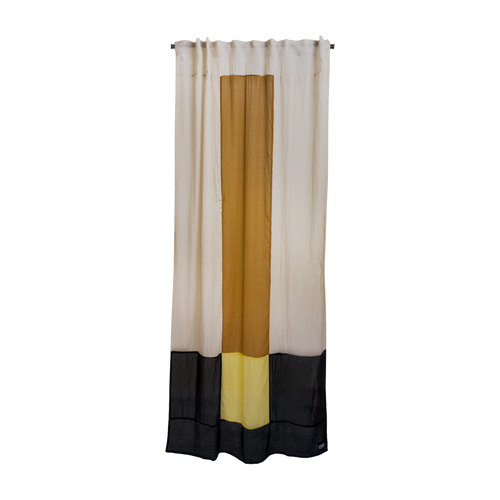
Close-up of Raw curtains in yellow, white and caramel tones

Buying guide

What length and width for your curtains?

A curtain is measured from the pole, not from the window: it is the pole that determines the height and width. This guide provides installation benchmarks, compares twelve curtains from the catalogue and covers patio doors, roof windows and small windows.

12 curtains compared6 curtain rod heightsupdated September 2026

Find your curtains in 30 seconds

1 / 4

Which window?

The room decides the fabric, the window the width.

At what height is the curtain pole fitted?

Measure from the top of the pole to the floor: the curtain is 1 cm shorter to just skim.

Which fabric appeals to you?

Linen filters, velvet softens, blackout blocks the light.

What budget per curtain?

The panel width and fabric account for most of the price difference.

Passer et lire le guide

Our recommendation

Deux alternatives sérieuses

Key takeaways

The length of a curtain is measured from the hanging point to the floor, minus 1 cm so it just touches. Position the rod 10 to 15 cm above the window and extend it 15 to 20 cm beyond each side. Allow for a fabric width equal to 1.5 to 2 times the rod length: for a 140 cm window, two panels of 145 cm. Standard heights are 250, 280 and 300 cm.

  • Position the rod before measuring: 10 to 15 cm above the frame, higher to make the room feel taller.
  • Curtain height = height below the rod minus 1 cm to skim the floor, plus 2 to 5 cm for a broken fall.
  • Rod = window width + 30 to 40 cm; fabric = 1.5 to 2 times the rod width.
  • Catalogue formats: 130 to 150 cm wide, 250, 280 or 300 cm high, extra-wide widths up to 350 cm.
  • A blackout curtain only blocks out light when hung high, wide and to the floor.

Length and height of curtains: the measurements to know

No standard defines the length of a curtain: it derives from the height at which you install the pole and the drop you want to achieve. The figures below are trade benchmarks from upholsterers and decorators, named as such. The dimensions of the curtains mentioned come from their title in the catalogue.

Length of curtains

Measure the drop height: from the hanging point to the floor. For an eyelet curtain, the hanging point is the top of the pole; for a curtain with clips, hooks or gathering tape, it is the bottom of the rings or track. Then subtract 1 cm if you want the curtain to graze the floor, add 2 to 5 cm for it to break slightly on it, 10 to 20 cm for a puddle effect. Measure on the left, in the centre and on the right: floors and ceilings are rarely straight, and it is the shortest dimension that matters for a grazing drop.

Height of curtains

The height of the curtain depends first on that of the pole. The trade benchmark is to install it 10 to 15 cm above the frame of the window. To visually heighten the room, raise it halfway between the frame and the ceiling, or just below the ceiling: the curtain then gains 20 to 40 cm in height and the window appears taller. A pole installed flush with the frame, on the contrary, squashes the window and leaves the wall visible above the fabric.

Height of curtains relative to the floor

Three drops exist. The grazing drop, 1 cm above the floor, is the neatest and easiest to maintain. The broken drop, 2 to 5 cm resting on the floor, gives a softer appearance and compensates for an uneven floor. The puddle, 10 to 20 cm on the floor, suits heavy fabrics such as velvet and low-traffic rooms: it collects dust, and one steps on it near French windows. Above a radiator or a window with a sill, stop the curtain 1 cm above the sill, or 10 to 15 cm below.

Standard curtain height

There is no official standard height, but dominant formats. Of the 166 curtains in the catalogue whose title indicates the dimensions, the heights are concentrated at 250, 280 and 300 cm, with some models at 260, 270, 298 and 350 cm. The 250 cm format suits the ceilings of recent housing; 280 and 300 cm suit poles installed high and period ceilings; 350 cm, high ceiling heights.

Curtains 3 metres in height

A 300 cm curtain hangs from a pole installed at around 300 cm: 310 to 320 cm ceiling in a period flat, or pole mounted at the ceiling to stretch a window. The catalogue offers heights of 298 and 300 cm (Madura Milos and Shadow, Raw Room) and, beyond, 350 cm models (Madura Lina, Carlina and the Santorini voile) for 3.50 m ceilings.

Curtains 220 height

Curtains 180, 210, 220 or 230 cm in height correspond to poles installed low: low ceiling, beam above the window, window with a sill whose height to the floor you want to cover. These formats are rare in ready-made; the simplest solution consists of taking a 250 cm curtain and shortening it with a hem, sewn or iron-on. Measure before cutting, curtain hung, and keep 1 cm margin for the grazing drop.

The table below links the height measured below the pole to the curtain height to choose. All formats are in our curtain collection.

Length and height of curtains: the measurements to know
Height measured under the poleCurtain to chooseDrop achievedTypical case
180 to 230 cm 250 cm shortened by a hem skimming the floor, after hemming low ceiling, beam, window with sill
245 to 250 cm 250 cm skimming the floor or breaking 1 to 5 cm ceiling of recent housing
255 to 260 cm 260 cm skimming the floor pole fitted 10 to 15 cm above the frame
275 to 280 cm 280 cm skimming the floor pole mounted halfway towards the ceiling
295 to 300 cm 298 or 300 cm skimming the floor period ceiling, pole at ceiling height
340 to 350 cm 350 cm skimming the floor very high ceiling

Calculation rule: curtain height = measured height between the hanging point and the floor, minus 1 cm to skim, plus 2 to 5 cm for a broken fall. Curtain pole: 10 to 15 cm above the window frame, or higher to make the window appear taller.
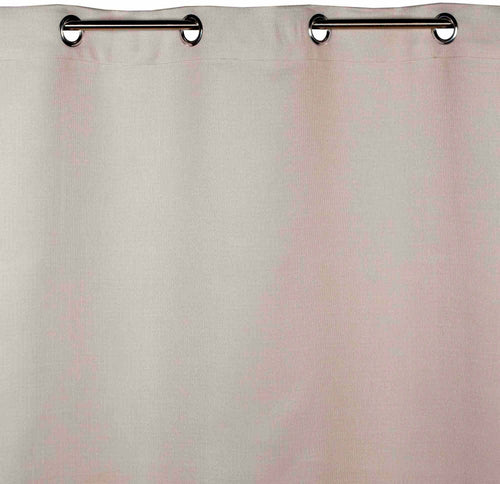
White blackout eyelet curtains by Madura falling to the floor in front of French windows, in a living room with grey armchairs
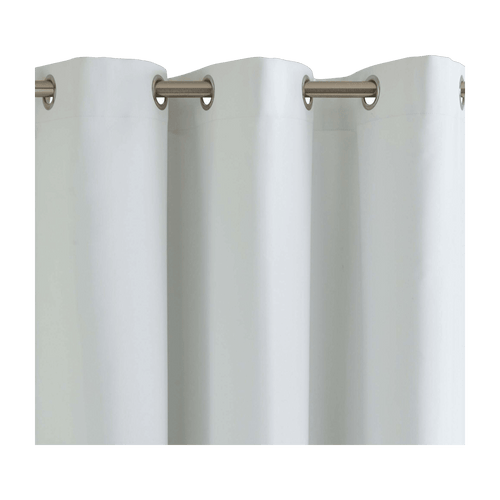
Madura, 145 x 270 cm eyelet blackout curtain: for it to graze the floor, the top of the curtain pole should be positioned at 271 cm.

View the Curtains collection →

Width of curtains and length of curtain rod

Curtain width

A curtain is not meant to be stretched flat: it needs fullness to form pleats, even when closed. The standard guideline is a total fabric width equal to 1.5 to 2 times the length of the curtain pole. Below 1.5, the closed curtain looks stretched and lets light through at the edges; beyond 2.5, it becomes bulky when open and obscures the window. In the catalogue, more than nine out of ten curtains whose title gives the dimensions measure 130 to 150 cm wide, and a few extra-wide models reach 200, 300 and 350 cm.

Calculating curtain width

The calculation is done in three steps. Measure the width of the window, including the frame. Add 15 to 20 cm on each side to obtain the length of the pole: the open curtain then sits against the wall and does not obscure the window. Multiply this length by 1.5 to 2 and divide by the width of one panel. Example: 140 cm window, 175 cm pole, requiring 260 to 350 cm of fabric, i.e. two 145 cm panels (290 cm, a fullness of 1.65) or three 140 cm panels for a more gathered effect.

How to calculate the length of a curtain pole

Length of pole = width of window + 30 to 40 cm. With heavy curtains (velvet, lined blackout), allow rather 25 to 30 cm on each side, as they take up more space when open. The pole must not hit a perpendicular wall or cupboard: if space is limited on one side, offset the whole assembly and open the curtain on one side only. Poles and their brackets are in the curtain pole collection.

At what height to install the pole

10 to 15 cm above the frame in most cases; higher to make the room appear taller; on the ceiling, on ceiling brackets, when the space between the frame and the ceiling is less than 20 cm. Install the pole before ordering: it is the pole that determines the height of the curtain, never the other way round.

The poles, brackets and finials from the publisher are brought together in the Madura curtain pole collection.

Width of curtains and length of curtain rod
Width of windowCurtain rod length (15 to 20 cm on each side)Total fabric width (fullness 1.5 to 2)Panels of 140 to 150 cm
80 cm 110 to 120 cm 165 to 240 cm 2 panels, one on each side
100 cm 130 to 140 cm 195 to 280 cm 2 panels
140 cm 170 to 180 cm 255 to 360 cm 2 panels, or 3 for a gathered effect
180 cm 210 to 220 cm 315 to 440 cm 3 panels
240 cm (patio door) 270 to 280 cm 405 to 560 cm 3 to 4 panels, or 2 wide widths of 200 to 350 cm
300 cm (patio door) 330 to 340 cm 495 to 680 cm 4 panels, or 2 wide widths of 300 to 350 cm

Recommended fullness (guideline): 1.5 to 2 times the curtain pole for eyelets or clips, 2 to 2.5 times for pencil pleat tape, 2 to 3 times for lightweight voile.

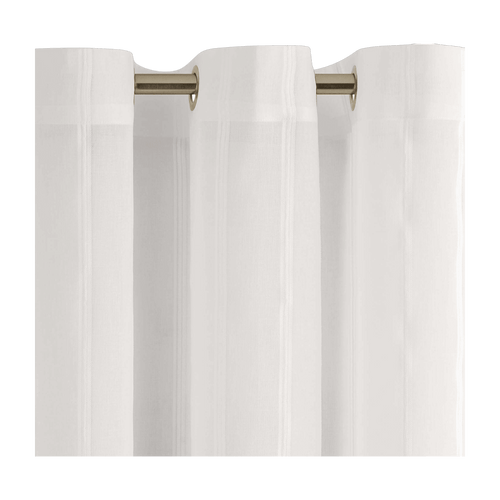
Two white Madura Milos eyelet curtains on either side of a tall window in a Haussmannian living room
Two Madura Milos panels of 145 cm width give 290 cm of fabric, enough to keep pleats on a curtain pole from 145 to 190 cm.

View the Curtain Rods collection →

Eyelets, pencil pleat tape, pinch pleats: the heading changes the calculation

Eyelet curtains

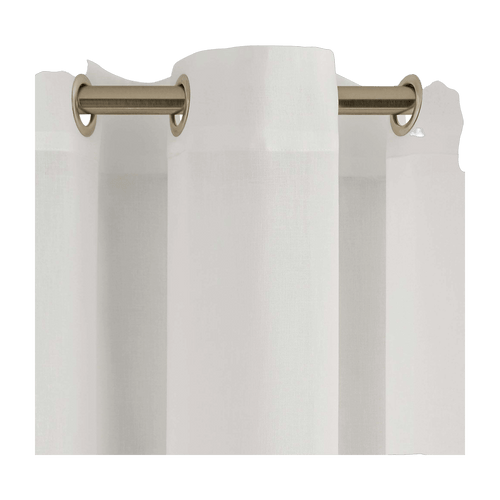
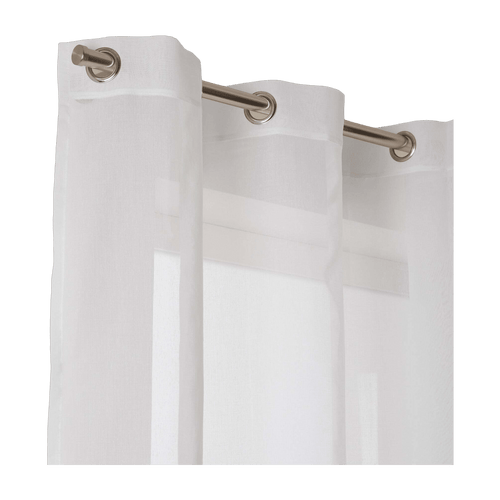
Rings sewn into the top of the fabric, threaded directly onto the pole. The pleats are regular and deep, the curtain slides well, and the top of the fabric extends slightly above the pole: it's the top of the pole that serves as the measuring point. Eyelets require a pole, not a track. A fullness of 1.5 to 2 is sufficient. This is the most common heading in the Madura catalogue (Milos, Thasos, Shadow, Lina, Carlina).

Pencil pleat tape

A tape sewn to the back of the curtain, with cords that you pull to gather the fabric, then hooks that attach to the rings or gliders of a track. It creates tight gathers and a more formal appearance, and can be adjusted to the nearest centimetre in width. It requires more fabric: 2 to 2.5 times the pole width. You measure the height from the bottom of the rings or glider.

How to attach curtains with clips

Clip rings slide onto the pole and clip the top of the fabric. Space them every 10 to 15 cm, starting with the two ends, and always clip at the same depth so that the bottom hem remains straight. To create regular pleats, clip the fabric alternately in valleys and peaks, every other clip. Clips allow you to hang fabric without a heading, a linen panel, a sheet or a voile, and to adjust the height by a few centimetres by clipping lower down.

How to shorten curtains that are too long

Three solutions without changing curtains. Raise the pole, if the gap to the ceiling allows: this is the neatest option. Fold the top of the fabric backwards and hold it with clip rings, for an excess of 5 to 15 cm. Make a hem, sewn or iron-on, beyond that. On eyelet curtains, the hem is always made at the bottom, as the eyelets fix the top. Clip rings and accessories are available in the Madura curtain pole collection.

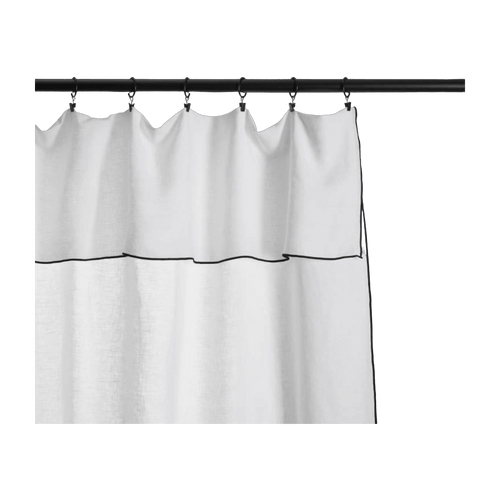
Madura Carlina white linen curtain with black border hanging from rings on a black curtain pole
Madura Carlina, white linen 150 x 280 cm, hung with rings: the height is then measured from the bottom of the rings.

Linen, voile, velvet, blackout: how the fabric makes a difference
Linen

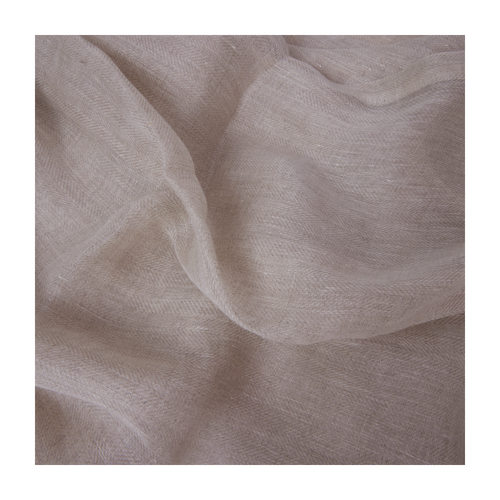
Linen filters light without blocking it, creases and drapes softly. When thick, it provides privacy during the day; as a voile, it allows the view through. Washed linen has already been softened and creases more evenly. It does not block light: in a bedroom, it should be doubled up or paired with a blind. Models can be found in the linen curtain collection.

Voile

A lightweight fabric (cotton voile, linen voile, fine polyester) that preserves privacy during the day whilst letting light in. In the evening, with lights on, it becomes transparent from outside: plan for a second curtain or blind for night-time. Voile can be hung alone, or on a double rod in front of a thick curtain.

Velvet

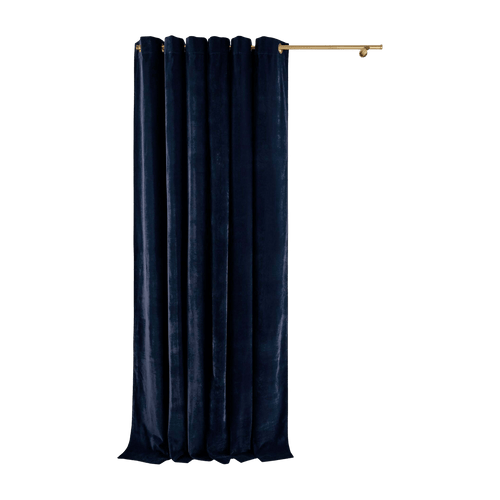
Heavy and dense, it hangs straight and dampens light and room noise. It requires a sturdy rod with closely spaced brackets, and suits a broken drape or pooling well. The Dario by Madura, in blue velvet measuring 137 × 260 cm, is one example.

Blackout

A very dense fabric or one coated on the reverse that blocks daylight. On its own, it does not achieve complete darkness: light passes through at the top, sides and bottom. For a bedroom, fit the rod high and wide, let the curtain graze the floor and allow for 20 cm overlap on each side. Blackout models can be found in the blackout curtain collection.

Thermal curtains

A thick or lined curtain creates an air gap in front of the glass and reduces the sensation of a cold surface near an old window. The effect depends mainly on installation: fabric to the floor, overhanging rod, top of curtain close to the ceiling. No insulation data is given in catalogue titles: judge by thickness and lining.

Polyester, finally, does not crease, keeps its colour in sunlight and washes easily: it is the material of Raw Room curtains. See the polyester curtain collection.

Madura Dario midnight blue velvet curtains with golden eyelets in a living room with mouldings, grey sofa and round coffee table
Madura Dario, blue velvet 137 x 260 cm: heavy and dense, it hangs straight and dampens both light and room noise.

View the Linen Curtains collection →

Colour and enhancing curtains

What colour curtains go with white walls

With white walls, three approaches work. Off-white or ecru extends the wall and makes the window disappear behind the light: this is the choice for small rooms. Natural linen, beige or sand warms up a cold white without creating contrast. Bold colour (terracotta, green, deep blue) makes the curtain a decorative element: repeat it in a cushion, rug or artwork in the same room. Avoid pure white against an off-white wall, which makes the wall look dirty.

How to show off your curtains

Mount the pole high and wide, let the fabric graze the floor and give it enough fullness: these three adjustments matter more than the fabric itself. Steam the curtain once hung to remove creases. During the day, hold it back with a tieback at mid-height or one-third from the bottom. Layer a voile and a thick curtain on a double pole to add depth. Light tones are in the white curtain collection and the beige curtain collection.

White House Doctor Plain White voile curtains framing a window above a bench with cushions, white walls
House Doctor Plain White: a white curtain against a white wall erases the window behind the light, the choice for small rooms.

View the White Curtains collection →

Bay windows, rooflights, small windows: special cases
Which curtains for patio doors

Patio doors require a continuous curtain pole or track, extended by 20 cm on each side, and wide curtains. Two panels of 300 to 350 cm (Madura Thasos or Shadow in 350 cm width) avoid multiplying 140 cm panels. If the patio door is used for passage, open the curtain on the side opposite to the opening, to avoid rubbing it with each passage. Combine with a wide voile curtain, such as the Santorini 300 x 350 cm, for daytime privacy.

How to fit curtains on a roof window

A standard curtain hangs in mid-air under a sloping roof window. Two solutions: one pole at the top and a second at the bottom of the window, which hold the fabric against the slope; or a blind adapted to the roof window, easier to operate. To dress a roof window with curtains, choose a lightweight fabric, such as a tab-top voile, which the two poles hold without distorting it.

Curtain length for a small window

Three possible lengths: to the sill (the curtain stops 1 cm above), below the sill (10 to 15 cm lower, which dresses the window better), or to the floor to enlarge the window and the room. In kitchens and bathrooms, a net curtain, fixed to the window frame, is sufficient. Blinds are in the blinds collection.

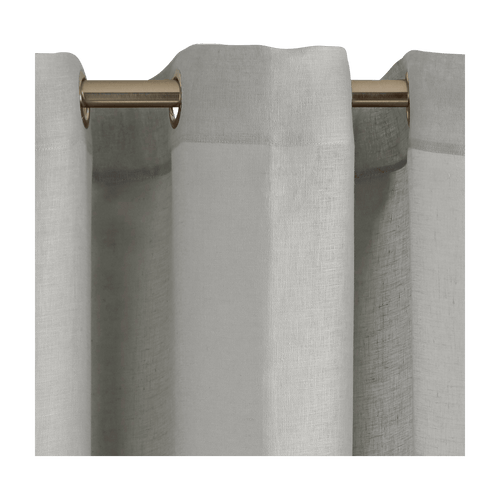
Light grey Madura Shadow eyelet curtains in front of a large French window, in a living room with black armchairs
Madura Shadow, 350 cm wide by 298 cm high: one panel per side is enough to dress a sliding door.

View the Blinds collection →

Which curtain brand to choose

Madura (France) covers the essentials of the catalogue: eyelet curtains, pencil pleat curtains, sheer curtains, blackout curtains, in heights from 250 to 350 cm and in large widths up to 350 cm, with matching curtain poles. See Madura curtains.

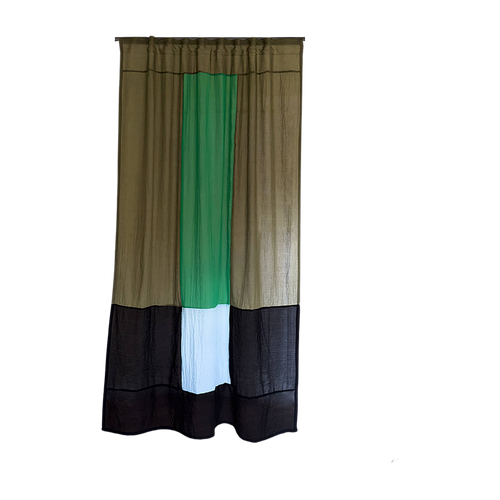
Raw Room prints patterns on polyester in 250 and 300 cm heights, for windows that become a graphic element. See the brand Raw Room.

Gabrielle Paris works with linen: thick linen, washed linen, herringbone linen voile, jacquard or striped, in 280 cm height. See the brand Gabrielle Paris.

Nobodinoz offers cotton sheer curtains in checks and stripes of 140 x 280 cm, designed for children's bedrooms. See the brand Nobodinoz.

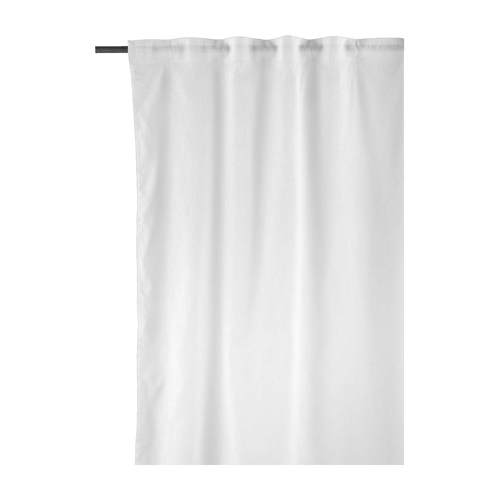
House Doctor (Denmark) publishes plain curtains, in white and brown-grey, to match its decorative universe. See the brand House Doctor.

View the Madura Curtains collection →

Practical examples

A living room with 250 cm ceiling height, 140 × 215 cm window

The frame leaves 35 cm to the ceiling: the rod is mounted at 245 cm, just below the ceiling, to make the window look taller, and measures 175 cm. Drop height: 245 cm, so a 250 cm curtain that breaks 5 cm on the floor, or shortened by 6 cm to just graze it. Width: 175 × 1.5 to 2, i.e. 260 to 350 cm, so two 150 cm panels (300 cm, a fullness of 1.7) like the Raw Room 250 × 150 cm.

A Haussmannian bedroom with 310 cm ceiling height, two 120 cm windows

Rod mounted at 300 cm, 160 cm long per window. To sleep in darkness, a blackout eyelet curtain on each side, but 270 cm models would leave a 30 cm gap: choose a 298 or 300 cm curtain (Madura Milos or Shadow) and pair it with a blackout blind fitted inside the reveal. Matching bed linen is chosen from the bed linen collection.

Raw Room Butter caramel curtains with yellow, orange and white stripes in front of the windows of a period living room with sofa and wicker trunk
Raw Room Butter caramel, 250 × 150 cm: under a 250 cm ceiling, two 150 cm panels give a width of 1.7 m on a 175 cm rod.

View the Curtains collection →

Care: washing and whitening curtains

How to whiten curtains

Follow the care label first. For a white curtain in cotton, linen or washable polyester, soaking for a few hours in warm water with added sodium percarbonate, then a gentle wash, revives the white without damaging the fibre. Avoid bleach on synthetics and on linen, which it can weaken or yellow. Hang the curtain on the rod whilst still damp to dry: its weight smooths out the fabric.

How to whiten yellowed curtains

Yellowing comes from sunlight, tobacco, cooking or washing with coloured linen. A first soak in sodium percarbonate is often enough; repeat it rather than increasing the dose. A curtain yellowed by the sun on one side only will not always return to its original colour: in this case, reverse the panels from time to time so that wear is even. Velvet and coated blackout curtains are dry-cleaned or treated according to the manufacturer's instructions. Machine-washable curtains are in the polyester curtain collection.

View the Polyester Curtains collection →

2026 trends: what our customers are choosing

What The Cool Republic orders placed between January and September 2026 show in the Curtains collection. Shares are counted by number of orders, not quantities, so that a large purchase doesn't weigh more than another.

The most requested brands

In order of orders: Nobodinoz, Raw Room, Madura.

The most ordered models since January

Method: orders placed on thecoolrepublic.com from 1 January to 30 September 2026, counted by number of orders containing the product; only models still on sale are listed. Data updated quarterly.

View the Curtains collection →

The criteria that matter

The criteria that matter
CriterionWhat it changesBenchmark figureThe pitfall
Curtain rod height The perceived height of the window and the room 10 to 15 cm above the frame, or halfway to the ceiling A rod flush with the frame: the window looks squashed
Curtain height How it falls to the floor Height below the rod minus 1 cm (grazing), plus 2 to 5 cm (breaking) Measuring the window instead of the height below the rod
Rod length The light that enters when the curtain is open Window width + 15 to 20 cm on each side A rod flush with the frame: the open curtain eats into the glass
Fabric width The folds, curtain closed 1.5 to 2 times the rod; 2 to 2.5 for a gathered heading tape A single 140 cm panel for a 180 cm rod: taut fabric, gaping edges
Curtain heading Installation and measuring point Eyelets: top of the rod; rings and tape: bottom of the rings Ordering a gathered heading tape for a rod without rings
Material Light, privacy, maintenance Sheer during the day; linen to filter; blackout or velvet for night A sheer curtain alone in a bedroom: transparent in the evening

Model comparison

ModelPriceDimensions in titleWidthHeightMaterialHeadingSuitable for which window
Blue velvet curtain 137 x 260 cm Dario €194,25n/an/an/an/an/an/a
Beige polyester curtain 250x150cm Butter caramel 1 €184,90n/an/an/an/an/an/a
Thick natural linen curtain 135x280cm €189,00n/an/an/an/an/an/a
White linen curtain 150x280 Carlina €139,00n/an/an/an/an/an/a
White eyelet curtain 145 x 298 cm Milos €89,00n/an/an/an/an/an/a
Green polyester curtain 300x150cm Forest haze 1 €192,90n/an/an/an/an/an/a
White eyelet curtain 145 x 270 cm Occultant €59,00n/an/an/an/an/an/a
White eyelet curtain 350 x 280 cm Thasos €109,00n/an/an/an/an/an/a
Light grey eyelet curtain 350 x 298 cm Shadow €259,00n/an/an/an/an/an/a
Santorini white eyelet sheer curtain 300 x 350 cm €159,00n/an/an/an/an/an/a
Light beige eyelet curtain 140 x 350 cm Lina €119,00n/an/an/an/an/an/a
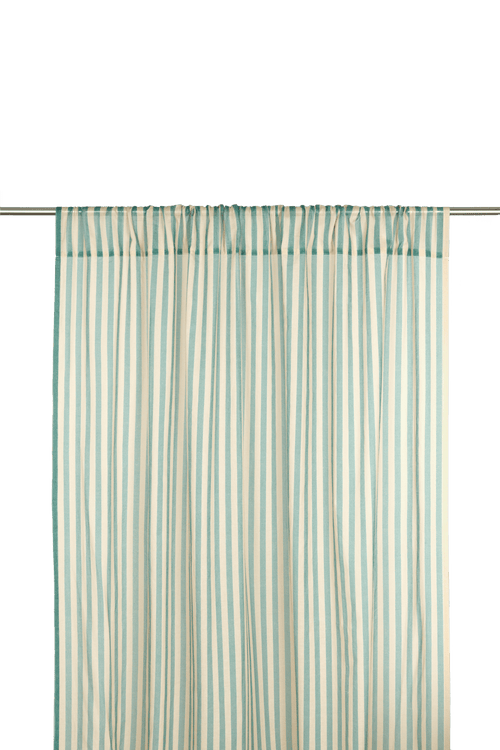
Curtain in turquoise blue striped cotton voile 140 x 280 x 1 cm Wendy €79,95n/an/an/an/an/an/a

Prices shown are the catalogue prices at the time you read this page.

Mistakes to avoid

  • Measuring the window instead of the height beneath the rod: curtains are ordered according to the fitted rod, never according to the frame.
  • Fitting the rod flush with the frame: the window looks cramped and the wall remains visible above the fabric; raise it by at least 10 to 15 cm.
  • Stopping the rod at the edge of the window: when open, the curtain covers 15 to 20 cm of glass on each side and darkens the room.
  • Taking a single 140 cm panel for a 180 cm rod: without fullness, the closed curtain is taut and lets light through at the edges.
  • Relying on a blackout curtain alone to achieve darkness: without a 20 cm overhang on each side and without reaching the floor, light gets through all around.
  • Leaving a curtain pooling in front of patio doors: it gets stepped on, wears out and collects dust; save pooling for windows with little traffic.

Frequently asked questions

How to choose curtains?
Start with the function: sheer curtains for daytime privacy, linen to filter light, blackout or velvet to sleep in the dark. Then fit the curtain pole 10 to 15 cm above the window and 15 to 20 cm wider on each side. Curtain height is measured below the pole; its total width should be 1.5 to 2 times the pole width.
What are the best blackout curtains?
Those that are properly fitted. An eyelet or pencil pleat blackout curtain, whether dense or coated on the reverse, only blocks out light if the pole extends 20 cm on each side, sits close to the ceiling and the curtain almost touches the floor. In a very exposed bedroom, pair it with a blind fitted within the window recess.
What are the best thermal curtains?
A thick or lined curtain, velvet or blackout, reduces the sensation of a cold surface in front of an old window by creating a layer of air against the glass. Installation matters as much as the fabric: curtain to the floor, overhanging pole, top of the curtain close to the ceiling. Catalogue descriptions do not indicate insulation values: judge by thickness and lining.
What curtain length for a small window?
Three options. To the sill, stopping the curtain 1 cm above. Below the sill, 10 to 15 cm lower, which dresses the window better. Or to the floor, which visually enlarges the window and the room, provided no radiator sits underneath. In the kitchen or bathroom, a net curtain fixed to the opening is often sufficient.
How to hang curtains?
Depends on the curtain heading. Eyelets thread directly onto the pole. Pencil pleat tape is gathered using its cords, then hooked with hooks to rings or a track. Fabric without a heading is attached with clip rings, every 10 to 15 cm. Curtains that are too long can be adjusted with a hem or by folding the top.
How to whiten yellowed curtains?
Check the label, then soak the curtain for a few hours in warm water with added sodium percarbonate before a gentle wash. Repeat the soaking rather than increasing the dose. Avoid bleach on linen and synthetics. Yellowing from sun exposure on one side only does not always come out: reverse the panels regularly.
What is the tassel on curtains called?
It is a tassel, a passementerie ornament made of threads gathered beneath a head. It often finishes the tieback, the cord or fabric band that holds the open curtain against the wall. The tieback is fixed at mid-height or the lower third of the curtain, on a wall hook positioned in line with the end of the pole.
Should curtain poles be left when selling a house?
As a general rule, elements fixed to the wall, such as poles and their brackets, are considered part of the property being sold, whilst the curtains remain with the seller. To avoid any disagreement, specify in the sale agreement what you are taking and what you are leaving, and have the point confirmed by the notary.