



Skip to content

-5% de remise supplémentaire sur tout notre OUTLET avec le code EXTRA5

Dès 150€ d’achats chez Serax, une carafe Fish&Fish est offerte. Ajoutez-la à votre panier !

BLACK MONTH Xmas Shop
Two people hang lit Fatboy Bolleke wireless lamps in a tree in the evening

Buying Guide · Portable Lighting

Portable cordless lamp: the complete guide to choosing the right one in 2026

Battery life, water resistance, colour temperature, format: the four criteria that really matter. Answer five questions and we'll suggest the right model and the relevant section of the guide to read.

19 models comparedLiving room · Terrace · OfficeUpdated in September 2026

Fatboy Bolleke: 20 hours of battery life, a suspension loop, and the table stays free

Find your lamp in 40 seconds

1 / 5

Where will this lamp live most often?

This is the parameter that determines the power and protection rating.

Will it be exposed to rain?

An indoor lamp left in the rain won't survive a season.

You're mainly looking for…

An ambient lamp and a reading lamp have neither the same lumens nor the same Kelvins.

What budget do you have in mind?

A cordless lamp costs more than an equivalent wired one: the battery and its management electronics.

Table or suspended?

On a small table, a suspended light frees up the entire surface.

Passer et lire le guide

Our recommendation

Deux alternatives sérieuses

Key takeaways

Four criteria determine usage satisfaction: battery life, water resistance, colour temperature in Kelvin, and the match between format and intended space. For a living room, warm light (2200 to 2700 K); for a terrace, IP44 minimum; for an office, the Kelvin range and low glare. Six to eight hours of battery life for an evening, ten to twelve for a working day. Design comes after, never before.

  • Battery life: six to eight hours at moderate intensity for an evening on the terrace, ten to twelve for a full working day.
  • Water resistance: a lamp exposed to rain must display at least IP44; staying outdoors permanently requires more.
  • Colour temperature: 2200 to 2700 K for the living room and dining table, 3000 to 4000 K for reading or working.
  • Charging: USB-C has become the most practical standard, the same cable as the phone or laptop.
  • Design comes second, never first.

How to choose a portable cordless lamp: the essentials at a glance

For a living room or dining room, the priority is warm light (2200 to 2700 K) and dimming, to modulate the ambiance according to the time of evening. For a terrace or garden, water resistance comes first: a lamp exposed to rain must show at least IP44, and staying outdoors permanently requires more. For a home office, it's the Kelvin range and low glare that make the difference to long-term visual comfort.

Battery life is relevant to all uses. An evening on the terrace requires six to eight hours at moderate intensity; a full working day, rather ten to twelve. USB-C charging has become the most practical standard: the same cable as your phone or laptop.

Our selection covers all these uses, from compact models under €100 for a small flat terrace to designer table lamps for the living room, including solar lamps designed to stay outdoors all summer long.

Four criteria determine satisfaction in use: battery life, water resistance, colour temperature in Kelvin, and the match between format and intended space. Design comes afterwards, never before.

Technical criteria to compare before buying

Comparing cordless lamps on design alone is like choosing a mattress by its colour. Here are the seven criteria to examine systematically, in order of priority.

  • Battery life. The number one criterion for portable use. Less than five hours at full power will be frustrating from the very first evening. Note: the stated autonomy almost always corresponds to the lowest setting. The Fatboy Bolleke lasts 20 hours in mode 1 but 8 hours in mode 3: the gap is normal and should be read in this way.
  • Water resistance. The IP44 rating protects against water splashes from all directions: it's the minimum for a covered terrace. A lamp that stays outside without shelter requires a specifically outdoor design.
  • Colour temperature. The 2200-2700 K range produces a warm light suited to evening atmospheres. 3000 to 4000 K is suitable for work and reading. Dim-to-warm models, which warm the tone as you lower the intensity, are the current refinement.
  • Luminous flux. For an ambient lamp, 100 to 300 lumens is sufficient. For reading or working, aim for 400 lumens and above: the Marset Bicoca delivers 478, the most powerful in our selection.
  • Weight and portability. Under 800 grams, a lamp can be moved without thinking. Beyond a kilo and a half, it stays where you've put it. A handle or suspension ring significantly broadens the possibilities.
  • Dimmer. Three fixed levels are sufficient for an auxiliary lamp. For office or reading use, a continuous dimmer is distinctly preferable: it allows you to adjust the lighting to the ambient brightness.
  • Charging method. USB-C is the most universal and longest-lasting standard. Some brands retain a proprietary magnetic cable, practical in use but not to be lost. Always check whether the cable is supplied.

Which battery life to choose to last all evening

Battery life depends on two inseparable variables: the capacity of the lithium-ion battery and the power consumed by the LED source. A manufacturer who announces twenty hours does so at the lowest setting, often below one watt. At full power, the same lamp may only last six to eight hours.

For an evening on a terrace or in a living room, the actual usage time is around four to six hours. Six to eight hours at medium intensity therefore represents a comfortable threshold: there is margin left without having to monitor the charge level. For restaurants, events or repeated summer evenings, aiming for twenty hours and more allows several services to be run without recharging.

Charging time is the most often overlooked criterion. The &tradition Caret MF1 recharges in 3 h 30 for 11 hours of battery life; the Flowerpot VP9 requires 8 hours for 10 hours of light. For equal use, the former recovers between two dinners, the latter is plugged in for the night. Some lamps also accept charging during use, which allows them to be left plugged in like a wired lamp when a socket is available.

Good battery practice. Avoid completely discharging the lamp before recharging it, and don't leave it permanently plugged in at 100%. Cycling between 20 and 80% significantly extends the lifespan of lithium-ion cells.
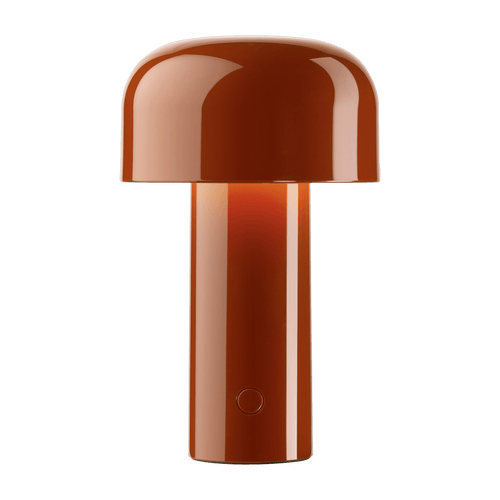
&tradition Caret MF1 portable table lamp placed on a white-tableclothed restaurant table
&tradition Caret MF1: 11 hours on one battery, 20 with the second. Enough to last an entire service without ever looking for a socket.

IP protection rating: what water resistance for outdoor use

The IP rating is defined by the international standard IEC 60529. It consists of two digits: the first indicates protection against solid particles (dust, sand), the second protection against liquids. For a portable outdoor lamp, it is the second that deserves attention.

  • IP44: Covered terrace. Protected against water splashes from all directions. The minimum acceptable under a pergola or awning. This is the rating of the Flowerpot VP9 and the Caret MF1.
  • IP54: Semi-exposed terrace. Adds partial protection against dust. Suitable for a partially covered garden where the lamp remains outside between uses.
  • IP65: Outdoors. Dustproof, resistant to water jets. The reference for an uncovered garden table, exposed to rain or automatic watering.
  • IP67 / IP68: Immersion. Resistance to immersion, reserved for pool lighting or ground-recessed luminaires. Rarely necessary for a portable table lamp.

In practice, most designer portable lamps are rated IP44: they withstand a passing shower but are not made to sleep in the rain. For genuine outdoor use, two approaches exist in the catalogue. Maiori solar lamps first, designed from the outset to remain outside all season: they recharge in the sun and have a magnetic USB dock when the weather does not allow it. Faro Barcelona outdoor lighting second, in aluminium and polycarbonate, whose technical specifications explicitly mention outdoor use.

Worth noting: intense cold damages the lithium-ion battery, not the IP rating. Even a lamp designed to stay outdoors benefits from being brought in before the first frosts.

Two Maiori La Lampe Parc solar lanterns lit on a wooden terrace at dusk
Maiori La Lampe Parc: charged by the sun during the day, it stays outdoors between two evenings without you having to think about it.

Charging, dimming and connectivity: what changes in everyday use

Beyond switching on and off, several functions directly influence the day-to-day experience.

The dimming function allows you to move from soft ambient lighting to brighter light for reading, without changing the light source. Three configurations exist. Fixed steps, the most common: &tradition offers 100%, 70% and 40% on the Flowerpot as on the Caret. Continuous dimming, more precise, found on the Flos Bellhop. And the dim-to-warm dimming of the Louis Poulsen PH 80, which warms the colour temperature from 3000 to 1800 K as the intensity decreases, just as a flame would.

The USB-C charging has become the standard: a single cable for the lamp, phone and computer. The Panthella 160 Portable V3 also accepts Qi induction chargers, allowing you to set it down in the evening on the same base as your phone. Several brands, however, retain a proprietary magnetic cable, including high-end ones: it's pleasant to plug in, but a cable to keep safe.

The replaceable battery is the technical point that separates a durable lamp from a disposable object. The Panthella 160 V3 incorporates a replaceable 18650 Li-Ion cell and LED, as do the Gubi Multi-Lite portable and the PH 80. On a lamp recharged daily, the question will arise after a few hundred cycles, or two to four years.

Portable Louis Poulsen PH 80 lamp lit on a garden table at dusk
Louis Poulsen PH 80: the dim-to-warm dimming ranges from 3000 to 1800 K. The lower you go, the closer the light gets to a flame.

What colour temperature for each ambiance

Colour temperature, measured in Kelvin, determines the perceived hue of light, from very warm orange-white to cool bluish-white. It directly influences a room's ambience and visual comfort depending on the activity.

Colour temperature scale, from very warm white at 1800 Kelvin to cool white at 5000 Kelvin.

  • 1800 à 2200 K: Candlelight effect, late evening
  • 2400 à 2700 K: Living room, dining table, bedside
  • 3000 K: Reading, kitchen, bathroom
  • 3500 à 4000 K: Office, precision tasks

For a living room or dining room, the 2200 to 2700 K range produces light similar to that of a candle or incandescent bulb. This hue encourages relaxation and a cocooning sensation: a portable lamp turned down low on a coffee table creates an intimacy comparable to that of a restaurant. This is the temperature of the vast majority of designer portable lamps, including the Flowerpot VP9, Panthella and Bolleke.

For an office or active reading space, the 3000 to 4000 K range is more suitable. At 3000 K, the light remains slightly warm but neutral enough not to tire the eyes during concentrated tasks: this is the value of the Hübsch Low. Beyond 4000 K, the light becomes stimulating but disrupts sleep if used in the evening.

A third case deserves attention: dim-to-warm models, where the hue automatically warms as you lower the intensity. The Louis Poulsen PH 80 thus goes from 3000 to 1800 K. A single lamp then covers reading at the start of the evening and the ambience at the end of a meal, making it the most versatile choice for a small flat where one lighting fixture must do everything.

Also look at the CRI (colour rendering index). Above 80, the colours of objects and food remain true; the Caret MF1 exceeds 85, which is noticeable on a set table.

&tradition Flowerpot VP9 wireless table lamp placed on a wooden dining table, warm evening atmosphere
&tradition Flowerpot VP9, 2700 K: the shade of incandescent bulbs, the one that makes a table inviting without switching on the ceiling light.

Cordless or corded lamp: what really sets them apart

Cordless lamps are essential in three situations: spaces without accessible sockets (terrace, garden, camping table), interiors where you like to move light sources around, and homes where electrical work is impossible. Corded lamps remain superior for fixed main lighting and high power output.

In practice, the two are complementary rather than competing: corded lamps provide basic functional lighting, whilst portable lamps create specific moods and follow usage patterns.

Cordless or corded lamp: what really sets them apart
CriterionPortable cordless lampMains-powered lamp
Mobility Total: from room to room, indoors or outdoors, with no socket constraint None: position fixed by cable length and socket location
Battery life Limited: 6 to 24 hours depending on model and intensity Unlimited as long as power is available
Installation Immediate: no cable, no tools Socket nearby, or electrical work for a wall light
Cost Higher for equivalent quality: battery and control electronics Lower, but may require building work
Power Moderate: 40 to 480 lumens, accent or ambient lighting High: up to several thousand lumens
Maintenance Battery to monitor, replace after several hundred cycles Bulb replacement if not integrated

Comparison: the best cordless lamps for patios and gardens

Eleven models available at The Cool Republic, listed from most affordable to top of the range. Specifications come from manufacturers' technical sheets and prices are those in the catalogue at the time you read this page.

n/a indicates data that the manufacturer does not publish. We prefer to indicate this rather than give an approximate figure: on battery life in particular, values circulating online often mix the lowest mode and full power.

The Maiori and Faro Barcelona models are designed to stay outdoors; the Fatboy and Market Set require sheltered space and are happily brought in during storms. For a small flat terrace exposed to rain, this criterion takes precedence over design.

See all cordless garden lights →

Market Set Singapore portable lamp in bamboo and cane placed on a wooden table by the water
Market Set Singapore: bamboo and cane, a portable format that sits on a table or hangs from a pergola beam.

View the Cordless Garden Lamps collection →

Fatboy, Maiori, &tradition, Louis Poulsen: which brand to choose

Each brand occupies a distinct territory. Understanding these differences allows you to choose not just a model, but a universe that aligns with your own tastes.

Fatboy is the obvious choice for a first purchase or for multiplying light sources on a large table without breaking the budget. Maiori addresses the one case the others don't cover: the lamp that lives outdoors. &tradition and Louis Poulsen cater to those seeking a durable design piece, with the decisive argument of a replaceable battery on the Louis Poulsen side. Flos and Marset stand out for pure performance: autonomy for one, light output for the other.

Fatboy, Maiori, &tradition, Louis Poulsen: which brand to choose
BrandPositioningIconic modelGood to know
Fatboy Dutch, casual outdoor, entry-level price Bolleke, Edison the Petit The best entry point: under €100 for a well-finished rechargeable lamp
Maiori French, outdoor solar lighting La Lampe Petite, La Lampe Parc The only solution truly designed to stay outdoors all season
&tradition Danish, reissues and contemporary creations Flowerpot VP9, Caret MF1 IP44 on both, three-level dimming, proprietary magnetic cable
Louis Poulsen Danish, mastery of light diffusion Panthella 160 V3, PH 80 Replaceable batteries and LEDs, USB-C, dim-to-warm dimming on the PH 80
Flos Italian, designer lighting Bellhop, Bon Jour Bellhop: 24-hour battery life and continuous dimmer, the most enduring for indoor use
Marset Spanish, functional and soft light Bicoca, Sips Bicoca: 478 lm and adjustable lampshade, the closest to a true reading lamp
HAY Danish, accessible design PC Portable, Host Slim, lightweight silhouettes (490 g), designed for small work surfaces
Several Louis Poulsen Panthella 160 portable lamps in different colours arranged in a dark interior
Louis Poulsen Panthella 160 Portable V3: replaceable battery and LED, USB-C or Qi induction. That's what makes it last.

Trends 2026: what's changing for cordless lamps

The rechargeable portable lamp market is experiencing several developments that reflect both aesthetic expectations and technical progress.

The first is the return to natural and textured materials. Blown glass, marble, woven bamboo and ceramic are emerging as alternatives to lacquered plastic. The New Works Kizu thus combines a marble base with a glass diffuser; the Market Set Singapore plays with bamboo and caning. These materials bring a crafted dimension sought after in interiors that favour authenticity. They also add weight that is not insignificant: the Kizu weighs 1.5 kg, worth considering if the lamp needs to move around a lot.

The second is repairability. After years of sealed lamps, several premium brands are making the battery and LED replaceable. This is the case with the Panthella 160 V3, the PH 80 and Gubi's Multi-Lite. For an object recharged every two days, the argument is solid: it doubles, even triples the useful lifespan.

The third is the widespread adoption of USB-C, including amongst brands that retained a proprietary connector, often accompanied by a discreet charge level indicator. The Flos Bellhop houses it under its base, which avoids a nasty surprise mid-dinner.

The fourth, finally, is indoor-outdoor hybridisation. Manufacturers are designing IP44-certified lamps with a design refined enough for the living room, without the robust appearance associated with outdoor lighting. A single lamp accompanies the meal indoors then moves out to the terrace for coffee: this is exactly the territory of the Flowerpot VP9.

New Works Kizu portable lamps in marble placed on a stone wall amongst plants
New Works Kizu: marble base, glass diffuser. The return of mineral materials, with the weight that comes with it: 1.5 kg.

Which lamp for a small flat terrace exposed to rain

It's one of the most common scenarios in town: a balcony under ten square metres, without a roof or partially covered, without an outdoor socket, in a building that prohibits permanent installations.

First criterion: water resistance. The lamp will be exposed to direct rain and night-time condensation. An indoor model will deteriorate within one or two seasons, with a risk of water infiltration into the electronics. Maiori solar lamps are designed exactly for this situation, and their solar recharging solves the absence of an outdoor socket at the same time.

Second criterion: format. On a small terrace, every centimetre counts. A lamp under 30 cm tall, or a model suspended from a balcony hook, takes up little space and doesn't obstruct circulation. The Fatboy Bolleke, with its 20 cm diameter and its hanging loop, frees up the entire table surface for under €80.

Third criterion: ease of bringing in. The lamp will probably be brought in during strong winds or at the end of the season. A weight under 700 grams and an integrated handle make this daily gesture painless. The Bolleke weighs 600 grams, the Fatboy Bellboy 1.1 kg but has a handle.

For this profile, the most rational combination remains a compact solar lamp for the fixed position, complemented by one or two lightweight pendant lights to hang on the railing. A ten-hour autonomy covers several consecutive evenings without daily recharging, which matters when the nearest socket is indoors.

Three Fatboy Edison the Mini wireless lamps distributed on a small round outdoor table
Fatboy Edison the Mini: three 15 cm points rather than a single large lamp. On a small table, it takes up the least space.

Which lamp for a home office

The desk imposes specific constraints: extended usage time, lighting that supports concentration without tiring the eyes, and flexibility to adjust the light throughout the day.

Luminous flux comes first. An ambient lamp with 100 lumens isn't enough to illuminate a work surface: it creates uncomfortable contrast between the screen and its surroundings. Aim for 300 lumens at minimum, ideally more. On this point, the Marset Bicoca, with 478 lumens and its adjustable lampshade, is the only one in the selection to perform in the category of true desk lamps.

Adjustability comes next. A lamp whose LED source is directly visible causes glare that becomes tiring after a few hours. An adjustable lampshade, an opaque diffuser or downward-directed light solves the problem: that's the approach taken by the HAY Host, whose slim profile diffuses towards the work surface without assaulting the eyes.

Colour temperature next. A lamp fixed at 2700 K will be too warm for prolonged screen work. Around 3000 K, as with the Hübsch Low, the light remains pleasant whilst retaining enough neutrality. Dim-to-warm models like the PH 80 offer the best of both worlds, at the cost of a significantly higher budget.

Battery life finally. A day of working from home requires eight to ten hours at moderate intensity. The Caret MF1 lasts 11 hours on one battery, and up to 20 with the second battery available as an option: it's the only model in the catalogue to offer this extension, making it the most rational long-term investment for this profile.

Marset Bicoca portable lamp switched on on a wooden desk, next to a notebook and a pencil
Marset Bicoca: 478 lumens and an adjustable lampshade. The only one in this selection that actually illuminates a worktop rather than providing ambient lighting.

Installing and maintaining your cordless lamp, step by step

  1. Define your needs before choosing. Identify the primary space, typical duration of use and desired ambience. These three parameters determine the required IP rating, the Kelvin range and the minimum battery life. Design comes last, from among the models that already meet these criteria.
  2. Perform a full initial charge before use. Fully charge the lamp upon receipt, even if the battery shows a partial level: the battery management electronics will calibrate the level correctly. The duration is indicated in the instructions.
  3. Position the lamp correctly. For a table lamp, place the light source at eye level or slightly below to avoid direct glare. For a pendant light, check that the mounting point supports the stated weight. Avoid placing the lamp on damp ground if it is not designed for outdoor use.
  4. Carry out routine maintenance. Clean with a slightly damp cloth and mild soap, without solvent or abrasive that would damage the finishes or seals. Check the charging connector regularly. Do not dismantle the waterproof seals to clean them: an incorrectly repositioned seal compromises the protection.

Charging and winter storage: best practice season after season

  1. Charge preventively. Do not wait until it switches off to recharge: repeated full discharge accelerates cell degradation. Recharge as soon as the level drops below 20 to 30%.
  2. Avoid permanent charging at 100%. A lamp left plugged in continuously keeps the battery at full charge, which generates slight overheating and accelerates chemical ageing. If the lamp is mostly used plugged in, unplug it once charging is complete.
  3. Prepare for winter storage. Before storing the lamp for winter, charge it to around 50 to 60%: this is the optimal level for long-term storage of a lithium-ion battery.
  4. Store in a dry, temperate place. Cells degrade below 0 °C and above 40 °C. An unheated garage can damage the battery; prefer an indoor cupboard or a frost-free utility room.
  5. Perform a check charge every two to three months. A battery left at 0% for several months can enter deep discharge, a state that is difficult to reverse.
  6. Inspect the seals in spring. Check for cracks, clean the connector with a dry brush and perform a full charge before the first evening of the season. If the observed battery life has noticeably decreased, the battery is approaching the end of its useful life. On models with a replaceable battery, this is a part to change, not a lamp to throw away.

Comparison: the best wireless lamps for the terrace and garden

ModelPriceBattery lifeLocationLightWeightChargingAdvantage
Anthracite pendant light Bolleke €61,70n/an/an/an/an/an/a
Set of 3 white cordless lamps Edison The Mini €87,20n/an/an/an/an/an/a
Cordless jungle green steel lamp 30 x 18 cm Bellboy €119,00n/an/an/an/an/an/a
Pack of 2 cordless lamps Edison the Petit €150,00n/an/an/an/an/an/a
Black aluminium portable outdoor lamp Toc €184,32n/an/an/an/an/an/a
Black wood portable lamp Take Away €191,40n/an/an/an/an/an/a
Yellow outdoor portable lamp in bamboo and cane 32.5 x 21.5 cm Singapour €190,00n/an/an/an/an/an/a

n/a indicates data not published by the manufacturer.

Mistakes to avoid

  • Comparing cordless lamps on design alone is like choosing a mattress based on its colour.
  • The stated battery life almost always corresponds to the lowest setting. The Fatboy Bolleke lasts 20 hours on setting 1 but 8 hours on setting 3: the difference is normal and should be read in this light.
  • An indoor lamp left out in the rain won't survive a season.
  • Intense cold damages the lithium-ion battery, not the IP rating. Even a lamp designed to stay outdoors benefits from being brought inside before the first frosts.
  • Avoid fully discharging the lamp before recharging it, and don't leave it permanently plugged in at 100%.
  • Do not dismantle the waterproof seals to clean them: an incorrectly repositioned seal compromises the protection.

Frequently asked questions

What battery life is needed for an evening on the terrace?
Six to eight hours at medium intensity comfortably cover a four- to six-hour evening with margin to spare. To manage several evenings without recharging, aim for twenty hours or more in the lowest mode, as offered by the Fatboy Bolleke and the Marset Sips.
Can a cordless lamp stay outdoors all summer long?
Only if it's designed for it. Maiori solar lamps and Faro Barcelona outdoor models allow this. An IP44 lamp like the Flowerpot VP9 withstands splashes and the humidity of a covered terrace, but not permanent exposure to rain. In any case, bring the lamp inside before the first frosts: it's the cold that damages the battery, not the water.
What colour temperature should you choose for a living room?
Between 2200 and 2700 K. This is the range that reproduces the light of a candle or an incandescent bulb, the most conducive to relaxation in the evening. Above 3000 K, the light becomes stimulating and is better suited to reading or working.
Can the battery in a cordless lamp be replaced?
It depends on the model. Louis Poulsen (Panthella 160 V3, PH 80) and Gubi (Multi-Lite) offer replaceable batteries and LEDs. Many entry-level lamps have a sealed cell: the lamp's lifespan is then that of its battery, several hundred charge cycles.
How many lumens are needed to read comfortably?
At least 300 lumens, ideally 400 or more, with a directed source that isn't directly visible. The Marset Bicoca (478 lm, adjustable lampshade) is the best placed in our selection. Below 150 lumens, you remain in the realm of ambient lighting.
USB-C, magnetic cable or induction: which should you favour?
USB-C for simplicity: the same cable as your phone and computer, and trivial replacement if lost. The proprietary magnetic cable, common at &tradition, is pleasant in daily use but brand-dependent. Qi induction, available on the Panthella 160 V3, is convenient for a lamp that returns to the same spot every evening.