



Entryway Rugs
Around a hundred hallway rugs and runners by Ferm Living, Layered, Lorena Canals or HAY, mostly in wool and jute, from the 60x90 cm doormat to the 80x250 cm hallway runner.
Entryway Rugs


Vendor: Layered
Rectangular wool rug summer sky 75x240cm Röllakan Ruth - Layered


Vendor: Normann Copenhagen
Hand-woven wool hallway runner rug blue 250x80cm Seam - Normann Copenhagen


Vendor: Normann Copenhagen
Hand-woven wool hallway runner rug grey 250x80cm Seam - Normann Copenhagen


Vendor: House Doctor
Hdtrip Nature doormat - House Doctor


Vendor: House Doctor
Hdindi doormat natural/black - House Doctor
How to choose a hallway rug
The essentials
A hallway rug is chosen first on the width of the passage: it should leave 10 to 20 cm of visible floor on each side. In a hallway 100 to 110 cm wide, that means an 80 cm rug, 200 to 250 cm long. Choose a thin, flat-woven one so that it clears the doors, and lay it on a non-slip rug underlay.
- Width: 70 to 80 cm in most hallways, with 10 to 20 cm of visible floor on each side.
- Length: that of the hallway minus 30 to 60 cm, so 80x200 cm for a 2.5 m hallway and 80x250 cm for 3 m.
- Material: flat-woven wool or jute for everyday foot traffic, coir for the doormat that traps dirt.
- Laying: a non-slip underlay on wooden or tiled floors, and a rug less than 1 cm thick near doors.
What size for an entrance hall rug or a hallway runner?
In an entrance hall, it is the width that decides. A rug that is too wide touches the skirting boards and looks like fitted carpet. Too narrow, it looks like a strip laid in the middle of the passage. The right benchmark: leave 10 to 20 cm of visible floor on each side. The length is then adjusted, keeping 15 to 30 cm of bare floor at each end.
| Your entrance | Recommended size | Visible floor |
|---|---|---|
| Square entrance hall or landing, less than 2 m long | 60x90 cm | The rug is placed in line with the door |
| Hallway of 2 to 2.5 m, 90 to 100 cm wide | 70x180 or 80x200 cm | 10 to 15 cm on each side |
| Hallway of 3 m, 100 to 110 cm wide | 80x230, 80x240 or 80x250 cm | 10 to 15 cm on each side |
| Hallway of 4 m and more | 80x350 cm, or two identical rugs laid end to end | 15 to 20 cm on each side |
Rules of thumb, to be adjusted to your measurements. In the selection, nearly eight rugs in ten are runner sizes, and 80x200 cm is the best represented.
Will the rug fit under the door?
This is the pitfall specific to the entrance hall. Measure the gap between the bottom of the door and the floor: it is often 1 to 2 cm. A flat-woven rug, 5 to 8 mm thick, fits in most cases, underlay included. A long-pile or very thick rug goes outside the swing of the door, or in a hallway with no hinged door.
See also
Wool, jute, cotton or coir: which material for a hallway rug?
The entrance hall is the hardest-working area of the home: people walk through it in shoes, sometimes wet ones. More than half of the rugs in the selection are wool, a dozen or so are jute, and the doormats use coir or jute. Each fibre has its own territory.
| Material | Underfoot | Resistance to foot traffic | Care | For which entrance |
|---|---|---|---|---|
| Flat-woven wool | Warm, supple, quiet | Very good, the fibre springs back into shape | Vacuum cleaner without a rotating brush, stains blotted with cold water | Indoor hallway used every day |
| Jute | Firm, raw texture | Good in dry conditions | Vacuum cleaner, does not like damp | Dry hallway, behind a doormat |
| Cotton | Light, soft | Average, marks more quickly | According to the label, some models are machine washable | Flat entrance, moderate foot traffic |
| Coir | Rough, it scrapes the soles | Very good | Shake out and brush dry | Doormat, just inside the door or outside a sheltered one |
| Synthetic fibres | Smooth, firmer | Very good | Damp sponge | Entrance exposed to rain and mud |
Comparison of the materials found in the selection of hallway rugs.
Doormat, small rug or hallway runner: which one should you choose?
The page brings together three families that do not do the same job. Hallway runners make up the bulk of it, doormats nearly a quarter. The choice depends on the shape of your entrance and on what you expect from the rug: stopping dirt, guiding the eye or warming the floor.
- The doormat, around 40x80 or 60x90 cm: it sits at the threshold and traps dirt. In coir or jute, it should be kept out of direct rain.
- The small rug, up to 90x150 cm: it suits a square entrance hall, a landing or the foot of a console table. It defines the space without getting in the way of the door.
- The hallway runner, 70 to 85 cm wide by 180 to 360 cm long: it follows your steps, muffles the sound of footsteps and visually lengthens the passage.
The two work very well together: a doormat at the threshold, then a hallway runner starting 50 cm to 1 m from the door. At Ferm Living, the Athens models in jute and Counter in wool are designed for this long format. HAY and House Doctor are behind most of the doormats.
Four hallway rugs from the selection
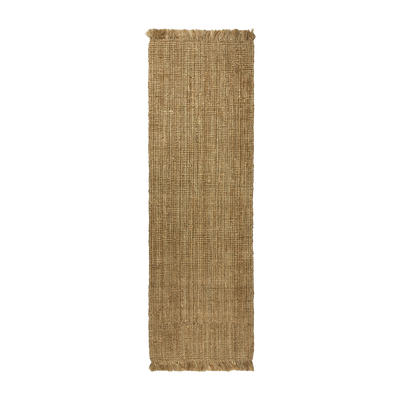
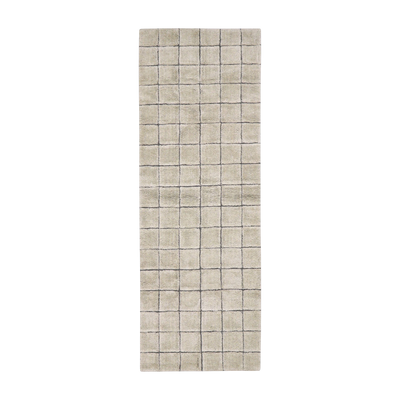
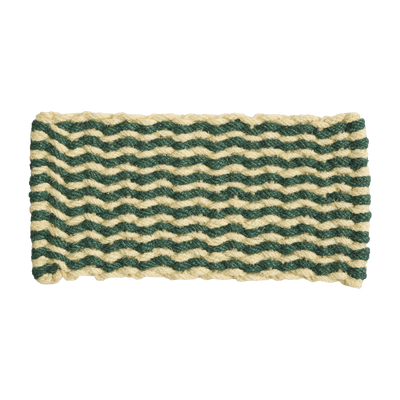
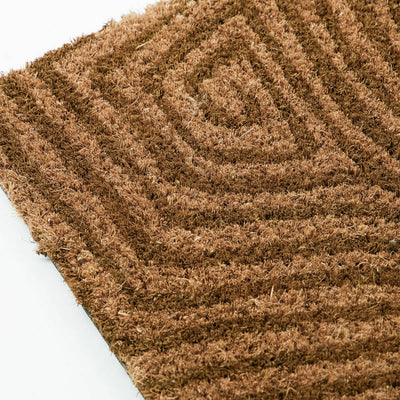
What colour and style for a hallway runner?
A hallway is often narrow and poorly lit. The rug takes up a large share of the visible floor there, so its colour matters more than in a living room. In the selection, brown and beige tones dominate, followed by green, blue and grey.
- To make a narrow hallway look bigger: a light rug, beige or ecru, and stripes running lengthwise, which stretch the perspective.
- To shorten a very long hallway: stripes running across or a repeated pattern, which give the passage rhythm.
- To hide marks: a mid-tone shade, flecked or patterned. Brown, dark green and two-tone weaves are more forgiving than plain white.
- To liven up a neutral entrance: a bold colour, yellow, blue or red, on a small size or a doormat.
The overall spirit is Scandinavian: flat weaves, understated geometric patterns, natural materials. Ferm Living, with around twenty references, Layered and Lorena Canals are the best represented makers, ahead of HAY and House Doctor. Nanimarquina and Muuto complete the selection with a few models each.
By colour and by style
Which rug for which entrance?
A narrow hallway with a wooden floor
In the hallway of a period flat, 90 cm to 1 m wide, stick to a rug of 70 to 75 cm to leave the wood visible on each side. A flat wool weave, plain or with a subtle pattern, lets the wooden floor remain the feature. Add a felt underlay, which protects the varnish.
With children or pets
Avoid long pile and very light colours. A tight, flat weave in a mid-tone shade vacuums in one pass and holds on to less pet hair. Loop-pile rugs are best avoided if your cat sharpens its claws. A 60x90 cm doormat at the threshold halves the work.
A door that opens straight into the living room
With no partition, the rug defines the entrance. A small rug or a runner laid in line with the door is enough to create a visual lobby. Pick up a colour from the living room rug without choosing the same model, and leave at least 50 cm of bare floor between the two.
An entrance exposed to rain
If the door opens onto the outside with no canopy, jute and coir suffer: they hold water and lose their shape. Go for a rug in synthetic fibres or a model designed for outdoors, and keep wool for the rest of the hallway.
On a tight budget
More than eight models in ten are offered at under €500, and more than a third at under €200: doormats, jute and cotton rugs, small sizes in wool. For the same budget, a simple rug in the right width is better than a precious rug that is too short.
For other rooms
How do you lay and care for a hallway rug?
A long, lightweight rug slips easily on a sealed wooden floor or on tiles. A non-slip rug underlay is therefore the first accessory to plan for: cut it 2 to 3 cm smaller than the rug on each edge, so that it stays out of sight. It also gets rid of wrinkles, which cause trips.
- Once or twice a week: vacuum in the direction of the weave. On wool, remove the rotating brush, which pulls out the fibres.
- Every week: shake the doormat outside and brush it dry.
- Every three months: turn the rug round by half a turn. In a hallway, people always walk down the middle: rotating it spreads the wear.
- If there is a stain: blot straight away with a clean cloth, without rubbing, from the edge towards the centre. A little cold water is enough on wool.
- Mud and soil: leave to dry completely, then brush and vacuum. Rubbing a wet mark works it in.
Jute does not tolerate water: blot, then leave to dry flat, in the open air. For cotton, follow the label before any machine wash. Avoid bleach and harsh stain removers on all natural fibres.
Frequently asked questions
What size of rug for an entrance hall?
What dimensions for a hallway runner?
Which material for a hard-wearing hallway rug?
How do you stop a hallway runner from slipping?
Which hallway rug should you choose with children or pets?
Can you lay a hallway runner on a wooden floor?
How do you care for a hallway runner?
How do you match the hallway rug with the living room rug?


Up to -15%

Up to -50%


Up to -50%


Up to -50%
Furniture
The Great Clearance

Special Sumo Offer
All at -15%

Lighting
The Great Clearance
Bathroom
The Big Clearance Sale

Kitchen
The Great Clearance
Decor
The Great Clearance
Textiles
The Great Clearance
Lifestyle
The Great Clearance
Garden
The Great Clearance
Kids
The Great Clearance

The Great Clearance
Up to -80%


Up to -20%


Up to -20%


Up to -30%


Furniture Offer
Up to -20%


Up to -30%

ARMCHAIR OFFER
All at -20%

FRENCH DAYS
Up to -30%


Up to -30%


Up to -30%

Up to -50%


Up to -50%


Up to -50%


Up to -50%


Up to -50%


Up to -50%