Skip to content

Livraison offerte dès 150€ d’achats en point relais · en France & Monaco

Dès 150€ d'achat Serax, une carafe Fish&Fish vous est offerte ! Ajoutez-la à votre panier.

Buying guide

Sun lounger and deckchair: dimensions, materials, storage

A sun lounger is chosen according to your height, the available space and the maintenance you're willing to accept. This guide gives the dimensions, compares the materials and eleven models from the catalogue, and explains how to prepare for the following season.

15 selected products11 models comparedupdated October 2026

The short answer

Choose the length first: your height plus 15 to 20 cm to lie flat. In our selection, flat sun loungers measure 201.5 to 212 cm long by 72 to 97 cm wide, reclining sun loungers 164 to 213 cm. Add 60 cm of clearance, 90 cm at the edge of a pool. In the sun, opt for teak, aluminium or resin and a seat that dries quickly.

Key takeaways

  • Length: your height plus 15 to 20 cm to lie flat (usage guide).
  • Width: 65 to 80 cm for reading or sleeping, 51.5 to 65 cm for a folding deckchair.
  • Footprint: furniture length plus 60 cm for passage, 90 cm around a swimming pool.
  • Outside all year round: teak, aluminium, treated steel, resin; bamboo, rattan and cotton under cover.
  • In October: clean, dry, cover with a breathable cover, cushions stored in a dry place.

The dimensions to know

What is the standard size of a sun lounger?

There is no standard dimension for outdoor relaxation furniture: each manufacturer sets its own measurements. However, the models in our selection fall into three clear families. Sun loungers that lie flat measure 201.5 to 212 cm long; reclining sun loungers with an adjustable backrest, 164 to 213 cm; compact formats for balconies, 136.5 to 145 cm. Folding deckchairs in wood and canvas and sling chairs fold up and store flat.

Sun lounger dimensions: length and width

The length is chosen according to your height. Our practical guideline: your height plus 15 to 20 cm to lie flat without your feet hanging over the edge. Above 1.85 m, look at models over 205 cm, such as the Fatboy Sunbud (212 cm) or the Vincent Sheppard Kodo (213 cm). The width ranges from 72 cm (Houe Click adjustable) to 97 cm (Fatboy Sunbud): below 70 cm, your arms quickly fall alongside the frame.

Sun lounger dimensions: the space required

The actual footprint is not the length of the furniture. Add a passageway at the foot and on one side: our practical guideline is 60 cm, 90 cm on a frequently used path, such as around a swimming pool. Between two sun loungers, leave room for a small side table to place a glass or a novel: this saves you from having to get up all the time.

Folding sun lounger: think about storage

A folded deckchair or sling chair forms a flat frame that can be slipped behind a door or against the wall of a shed. A fixed sun lounger, however, retains its length all year round: before choosing a 2 m model, check that it fits through the garage or shed door where it will spend the winter.

Sun lounger width: what seat for comfort?

The folding deckchairs in the selection measure 51.5 to 65 cm wide: enough to sit reclined, not to sprawl. For reading or dozing for long periods, a sun lounger 65 to 80 cm wide is more comfortable.

The dimensions to know
TypeLength measured in the selectionWidth measuredPositionWhere to place it
Flat sun lounger 201.5 to 212 cm 72 to 97 cm lying down, adjustable backrest poolside, lawn
Sun lounger with raised backrest 164 to 213 cm 65 to 80 cm semi-reclined terrace, reading nook
Compact sun lounger 136.5 to 145 cm 60 to 66 cm reclined seat balcony, small terrace
Folding deckchair, sling chair variable, folds 51.5 to 65 cm reclined seat balcony, beach, storage
Hammock 210 to 330 cm 115 to 138 cm suspended between two anchor points or on frame

Rule of thumb: length of sun lounger = your height + 15 to 20 cm; floor space = length + 60 cm walkway at the foot, and 60 cm on the side from which you get up.

View the Sun Loungers collection →

Sun lounger, deckchair, steamer chair, director's chair: the differences

The four terms overlap in catalogues, yet they describe different uses.

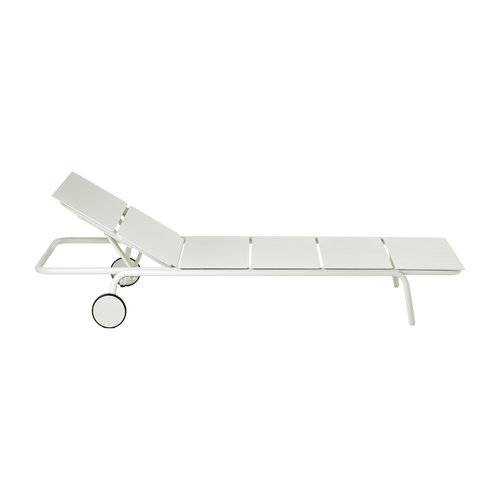
  • The sun lounger is low and long. It lies flat for sunbathing on your stomach, its backrest adjusts by notches. Example: the Fatboy Sunbud, in aluminium with its mattress.
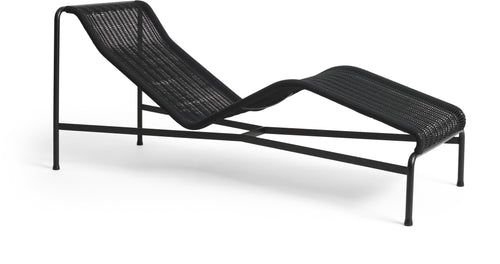
  • The daybed keeps a raised backrest and a higher seat: you read, nap, and get up effortlessly. The HAY Palissade by the Bouroullec brothers is the archetype.
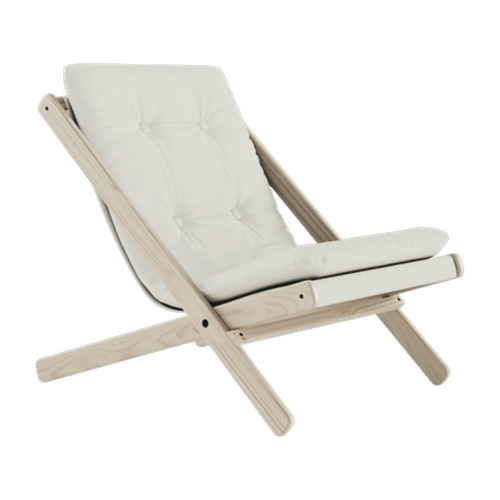
  • The deck chair, strictly speaking, is a canvas stretched over a folding wooden frame, like the Karup Design Boogie or the Business & Pleasure The Sling. Lightweight, it follows the sun and stores against a wall.
  • The director's chair is a deck chair without leg rest: seated, feet on the ground, with a much shorter footprint. The Pôdevache Palmier director's chair in wood and printed canvas is a good example.

The hammock completes the family: the Fatboy Headdemock Superb stands on its own steel structure (270 x 138 x 110 cm), without tree or supporting wall. The full selection is in the hammock collection.

In practice, many gardens combine two families: a fixed sun lounger in the sunniest spot, and one or two folding deck chairs for guests, the beach or the far end of the garden. The former stays in place all season, the latter store away in seconds.

A clarification: the term deck chair also refers to the infant seat. This guide covers outdoor furniture for adults only.

View the Hammocks collection →

Swimming pool, terrace, balcony: choosing according to location

By the poolside

The floor is wet, the sun is direct and there's constant to-ing and fro-ing. Choose a structure that isn't affected by water (aluminium, teak, resin, plastic) and a seat that dries quickly: slats, openwork fabric, rope. Flat sun loungers, like the Houe Click ajustable in metal and plastic, can be rinsed with a hose. Leave 90 cm of passage space on the pool side.

On a terrace or in the garden

A terrace calls for a sun lounger with a raised backrest, which serves as a reading chair as much as a nap bed. On a lawn, a wide base or slats placed on the ground sink less into damp grass than a slender foot. Under a tree, sap, leaves and droppings stain light-coloured fabrics: a structure that can be washed and a removable cushion cover make life easier. Consider shade: a sun lounger facing due south needs a parasol for the hot hours.

On a balcony

Measure the usable depth, including the balustrade. A 1.50 m long balcony can accommodate a compact sun lounger like the Houe Click sunlounger (143 × 60.5 cm) positioned parallel to the façade, or a folding lounger that can be folded away after use. On smaller balconies, the deck chair remains the most flexible solution. Folding models are brought together in the collection of folding sun loungers.

View the Folding sun loungers collection →

Teak, aluminium, steel, bamboo, resin: how the structure makes a difference

Teak sun lounger

Teak is the reference wood for outdoors: dense and naturally oil-rich, it withstands moisture without treatment. Left untreated, it develops a silvery-grey patina in one season; teak oil or sealer preserves its honey tone. The Cane-Line Amaze sun lounger is one example. Wooden models are in the wooden sun lounger collection.

Aluminium

Aluminium doesn't rust and remains light to move: it's the right choice for a sun lounger that follows the sun. The Serax August and the Fatboy Sunbud are made from it. The downside of lightness: in strong wind, a light model should be stored or weighted down. See the aluminium sun loungers.

Steel and metal

Heavier, steel is stable in wind. It's protected by galvanisation or powder coating (thermolacquering): a scratch that reaches the metal can be quickly touched up to prevent rust. The HAY Palissade combines steel and rope, the Business & Pleasure The Al Fresco an antique white metal frame and a cushion.

Bamboo, rattan and beech

Bamboo and rattan (Bloomingville Dione) bring a natural touch but fear prolonged moisture: under an awning, and stored away in winter. The beech of the Boogie is not a durable outdoor wood: it should be brought in after use.

Plastic and slats

Plastic slats on a metal frame, as on the Houe Click, fear neither chlorinated water nor sun cream and can be rinsed with a hose. Coloured plastic eventually fades after several summers in full sun: gentle cleaning is enough, without abrasive products.

Resin and cordage

Woven polyethylene fibre and polypropylene cordage, on the Vincent Sheppard Loop, resist water and UV and can be washed with soapy water.

View the Wooden sun loungers collection →

Canvas, textilene, cushion: seating and sun resistance

The frame lasts for years; the seat is what wears out. Three families share the models.

  • Stretched canvas (cotton, polyester) covers folding deckchairs. Cotton is soft but retains moisture: it should be brought in at night and dried before being folded.
  • Textilene, a weave of polyester threads coated with PVC, doesn't retain water, dries in a few minutes and resists UV well: it's the seating for poolsides.
  • Slats, rope and woven resin allow air and water to pass through. They benefit from a cushion for long naps.

Textilene is cleaned with soapy water and a soft brush, without solvent which would attack the coating. A cotton canvas is brushed dry then washed according to the label, and put back in place perfectly dry. Rope is brushed and rinsed; let it dry in the sun before covering it.

All canvas eventually fades in the sun. A solution-dyed thread, like certain outdoor acrylics, keeps its colour longer than surface-printed fabric. For a cushion, look at three points: a removable cover, foam that dries quickly and fastenings that prevent it from slipping. The HAY Palissade quilted cushion is designed for the sun lounger from the same collection, the Cane-Line Amaze seat cushion for the teak deckchair.

Cushions should be stored in a dry place as soon as the dew falls: it's the action that extends their life the most. The full range is in the collection of cushions for garden chairs.

View the Garden Armchair Cushions collection →

Backrest, armrests, height: the adjustments that matter

An adjustable backrest

A good sun lounger transitions from sitting position to flat position in notches. The flat position is for tanning on your stomach, the raised position for reading. Check that the adjustment can be made without standing up and that the notches hold firm under the weight of your back.

Seat height and armrests

The lower the seat, the more effort it takes to get up: a sun lounger 38 cm high (Houe Click adjustable) is exited by rolling to the side, whilst a high-backed sun lounger like the Loop (103 cm high) is exited like an armchair. For someone with knee pain, armrests and a higher seat make all the difference.

Larger build

Above 1.85 m, apply the rule of height plus 15 to 20 cm and read the maximum load indicated by the manufacturer. Outdoor seating is governed by standard NF EN 581 (part 1 for general safety, part 2 for seating strength): its mention on the manufacturer's datasheet is a good indicator of sturdiness.

The little extras

A headrest, an included mattress, wheels or handles for moving a heavy model: all details to check on the product sheet before choosing. HAY, for example, offers a headrest cushion for the Palissade collection, which sits on top of the backrest. On paved surfaces, pads beneath the feet prevent scratching the stone and hearing metal scraping with each adjustment.

View the Aluminium sun loungers collection →

Which brand for which style?

All the brands mentioned in this guide are available in our catalogue. Each has its own approach to garden relaxation.

  • HAY (Denmark): the Palissade collection by the Bouroullec brothers, in steel and rope, with matching cushions and cover.
  • Fatboy (Netherlands): generous and colourful pieces, from the Sunbud sun lounger to Headdemock hammocks.
  • Houe (Denmark): playful and practical formats, the entire Click range in metal and plastic, from sun loungers to compact formats.
  • Serax (Belgium): the August deckchair in aluminium, with low lines.
  • Vincent Sheppard (Belgium): weaving and rope, with the Loop and Kodo sun loungers.
  • Cane-Line (Denmark): teak and matching cushions, with the Amaze line.
  • Business & Pleasure (Australia): the beach club spirit, stripes and colourful fabrics.
  • Karup Design (Denmark) and Pôdevache (France): folding deckchairs and sun loungers in wood and fabric.
  • Bloomingville (Denmark): natural materials, such as the rattan of the Dione sun lounger.
  • HKliving (Netherlands): cotton hammocks and covers to protect outdoor furniture.

View the Sun Loungers collection →

Choosing in autumn: preparing for the next season

Autumn is a good time to choose: summer has just shown what was missing, and the empty terrace is easy to measure.

  • Note the path of the sun. Mark where the shade fell during the hot hours of last summer: that's where to place the sun lounger, or the parasol.
  • Measure the empty space. Without furniture, mark out on the ground the length of the model you're considering and the 60 cm walkway, then lie down on the area.
  • Think about winter before summer. Where will the furniture spend the cold months? A fixed 2 m sun lounger requires a garage or a cover; a folding one can be stored in a cupboard.
  • Compose the whole. A side table, an outdoor rug and a cordless lamp transform two sun loungers into a relaxation area. garden side tables are chosen at seat height, lower for a sun lounger than for a deck chair.
  • Test the position. Check the number of backrest notches, the seat height and the presence of armrests: these are what determine whether you'll read or sleep.

View the Parasols collection →

Practical examples

A pool deck for four

Four sun loungers 72 cm wide (Houe Click adjustable) separated by three side tables of 45 cm require 4 x 72 + 3 x 45 = 423 cm of deck length. In depth, 201.5 cm of sun lounger plus 90 cm of passage on the pool side: allow nearly 3 m.

A 3 m deep terrace

A HAY Palissade sun lounger of 164 cm, placed perpendicular to the façade, leaves 136 cm in front of it: enough for the 60 cm passage and a coffee table. A 212 cm sun lounger would fit there, but without circulation.

A narrow balcony

On 1.20 m of depth, no sun lounger fits crosswise. Two options: a compact sun lounger placed along the façade, or a Pôdevache deck chair that folds and stores against the wall after use.

A family garden

Two adults sunbathing, children coming and going: two fixed sun loungers near the lawn, plus two folding deck chairs that follow the children to the bottom of the garden or to the beach. The folding ones are stored in the shed in the evening, the fixed ones remain in place under their cover.

A tall person taking a nap

For 1.90 m, the guideline gives 205 to 210 cm. The Fatboy Sunbud (212 x 97 cm, mattress included) offers both the length and width to sleep without restraint.

View the Sun Loungers collection →

Maintenance and winterisation: preparing for the next season

October is the right time to put away sun loungers: a piece of furniture brought in clean and dry will be ready to use again in spring without any effort.

  1. Clean. Warm soapy water and a soft brush for all frames. No pressure washer on teak: it tears out the soft fibres and makes the wood rough.
  2. Dry. Allow to dry completely, including fabric and cushions, before folding or covering. A folded damp fabric will develop mildew stains.
  3. Protect. Teak can be treated with oil or a wood stain; steel can have paint touch-ups on chips; aluminium just needs a rinse.
  4. Store or cover. Bamboo, rattan, beech and cotton fabrics spend winter indoors. Outdoor frames can stay outside under a breathable cover, such as the HKliving sun lounger cover or the HAY tarpaulin for Palissade sun loungers.
  5. Raise. Place the feet on blocks so they don't sit in stagnant water, and allow air to circulate under the cover.

Each material has its own rhythm. Oiled teak receives a new coat once or twice a year if you want to maintain its colour; left grey, it only needs brushing. Steel should be checked at welds and feet, where water collects. Aluminium and resin only need a rinse in spring.

Cushions should be stored in a dry, ventilated place, upright rather than stacked. In spring, tighten the screws and check the backrest notches before the first nap. The covers are gathered in the covers and protections collection.

Never cover wet furniture in a sealed, waterproof cover: moisture becomes trapped, wood blackens and metal oxidises.

View the Covers and protection collection →

The criteria that matter

The criteria that matter
CriterionWhat it changesBenchmark figureThe pitfall
Length Lying flat without your feet sticking out Your height + 15 to 20 cm (rule of thumb) A 164 cm sun lounger for a 1.90 m sleeper
Width Comfort for the arms and napping 65 to 80 cm for reading, 51.5 to 65 cm for a folding lounger A narrow lounger chosen for sleeping
Floor footprint Circulation around the furniture Length + 60 cm walkway, 90 cm at the edge of a pool Measuring the furniture, not the space to stand up
Position Sunbathing, reading or sleeping Low flat sun lounger, high-back chaise longue A flat sun lounger for someone who mostly reads
Structure Outdoor durability and weight to move Teak, aluminium, treated steel, resin outdoors Bamboo, rattan or beech left in the rain
Seat Drying and colour fastness Textilene or solution-dyed yarn in the sun A cushion left outside every night

Our selection by use

By the pool, for sunbathing flat

At the poolside, for sunbathing flat

On the terrace, for reading and napping
Cane-Line

Amaze teak sun lounger

€2.380,00

Available

A teak deckchair that weathers in the sun or keeps its colour with oil.

teak · optional Amaze seat cushion · terrace or poolside

Budget: over £2,000

View product

On a balcony or to move around following the sun

On a balcony or to move with the sun

On a balcony or to move around to follow the sun

To equip and protect one's sun lounger

To equip and protect your sun lounger

HKliving

Cover for outdoor lounge chair

€119,00

Available

A polyester cover to protect an outdoor sun lounger between seasons.

for outdoor sun lounger · polyester · off-season protection

Budget: under £150

View product

View the Sun Loungers collection →

Eleven sun loungers and deckchairs compared

n/a: dimension not reliably stated on the product sheet.

Mistakes to avoid

  • Choosing by the stated length without comparing it to your height: if it's less than your height plus 15 cm, your feet stick out as soon as the backrest is flat.
  • Measuring only the furniture: a 212 cm sun lounger needs nearly 2.70 m depth with 60 cm clearance.
  • Leaving the cushions outside all season: dew alone is enough to soak them, the foam goes mouldy and the colour fades.
  • Using a pressure washer on teak: the jet rips out the soft fibres and leaves rough wood; a soft brush is enough.
  • Covering furniture that's still damp with a waterproof cover: trapped moisture blackens the wood and oxidises the metal.
  • Leaving a lightweight aluminium sun lounger outside in high winds: it will move; store it or weigh it down.

Frequently asked questions

What is the standard size for a sun lounger?
There is no standardised size. In our selection, a sun lounger that lies flat measures 201.5 to 212 cm long by 72 to 97 cm wide, a reclining lounger with raised backrest 164 to 213 cm, a compact format for balconies 136.5 to 145 cm. Allow for your height plus 15 to 20 cm to lie flat.
What is the difference between a deck chair and a sun lounger?
A deck chair, strictly speaking, is a piece of fabric stretched over a folding frame: you sit reclined and fold it away after use. A sun lounger is longer and lower, lies flat for sunbathing and stays in place on the terrace or by the pool. A reclining lounger keeps the backrest raised for reading.
What width should I choose for a sun lounger?
For reading or napping, allow 65 to 80 cm wide: the arms rest on the seat rather than alongside the frame. Folding deck chairs, 51.5 to 65 cm, are suitable for sitting breaks. For sleeping or sharing the lounger with a child, the widest models in our selection reach 97 cm.
Which sun lounger should I choose for a swimming pool?
A structure that is not affected by water, such as aluminium, teak, resin or plastic, and a seat that dries quickly: slats, rope, textilene. Avoid cotton, rattan and bamboo right beside the pool. Allow 90 cm of walkway on the poolside and a side table between two sun loungers.
Teak or aluminium for a sun lounger?
Teak is heavier and more stable, naturally resists moisture and takes on a grey patina if not oiled. Aluminium does not rust, can be moved with one hand and cleans with a rinse, but a lightweight model must be stored or weighted down in high winds. The choice mainly depends on the maintenance you are prepared to accept.
Can a sun lounger be left outside in winter?
Structures in teak, aluminium, treated steel or resin can remain outside, clean, dry, raised and covered with a breathable cover. Bamboo, rattan, beech and cotton fabrics spend the winter indoors. Cushions should always be stored in a dry, ventilated place, upright rather than stacked.
Which deck chair for a small balcony?
First measure the usable depth of the balcony. Under 1.20 m, a sling chair or folding deck chair, which folds away after use, remains the most flexible solution. Beyond that, a compact reclining lounger of 143 cm such as the Houe Click sunlounger fits along the façade whilst leaving a walkway in front of it.
Which reclining lounger for a tall person?
Apply the guideline of height plus 15 to 20 cm: for 1.90 m, look for at least 205 cm long. The Fatboy Sunbud (212 cm, 97 cm wide) and the Vincent Sheppard Kodo (213 cm) are suitable. Also check the maximum load indicated by the manufacturer and the presence of armrests for getting up.